Technical Article
Industrial Microwave Dryer vs Hot-Air Dryer: Cost, Quality and Process Selection
Choosing between an industrial microwave dryer and a hot-air dryer is not a contest between a “fast” machine and a “slow” machine. The correct choice depends on how much water must be removed, how the product absorbs heat, the permitted product temperature, required throughput, quality limits, available utilities and whether the process must also deliver a validated heating or sterilization outcome.
For many continuous snack, pet-food and fish-feed lines, hot-air drying remains the practical primary moisture-removal step. Microwave processing becomes more attractive when rapid internal heating, shorter residence time, final-moisture control or a separate thermal-treatment objective creates enough value to justify material testing and tighter process control. Some projects use both technologies in stages.
Microwave dryer vs hot-air dryer at a glance
| Decision point | Hot-air dryer | Microwave dryer | Hybrid route |
|---|---|---|---|
| How heat reaches the product | Heated air transfers energy to the surface; heat and moisture then move through the product. | The electromagnetic field interacts with moisture and other dielectric components, generating heat within the load. | Convective air removes bulk moisture while microwave energy intensifies a selected stage. |
| Typical project strength | Robust continuous drying across a wide capacity range with familiar utilities and controls. | Rapid internal heating for suitable, well-characterized materials and defined process outcomes. | Reduces the burden on one technology when the product benefits from staged moisture removal. |
| Main sizing inputs | Water-removal load, residence time, bed depth, belt area, airflow, exhaust and heat source. | Material dielectric response, loading depth, field uniformity, power density, residence time, exhaust and cooling. | The moisture and temperature condition at the handover point between stages. |
| Common project risk | Surface drying, insufficient residence time, uneven air distribution or an undersized exhaust system. | Hot spots, cold spots, arcing risk from unsuitable conditions, uneven loading or excessive temperature rise. | Poorly defined stage boundaries, duplicated controls or no agreed benefit for the extra equipment. |
| Best way to compare proposals | Finished-product throughput at stated inlet and outlet moisture, not oven length alone. | Test results for the actual material and load, not installed microwave power alone. | Total line output, quality, energy and control performance across both stages. |
Practical conclusion: a supplier should not recommend either route from the product name alone. “Spice,” “snack,” “pet food” or “fruit” does not define particle size, bed depth, incoming moisture, permitted temperature or the required quality result.
Start with water removal, not machine capacity
Hourly wet-material input is not the same as hourly dried-product output. A dryer must be sized around the mass of water removed and the permitted residence time. Moisture values must also state whether they are on a wet basis or dry basis. The FAO definition of moisture content distinguishes these two bases; mixing them can create a serious sizing error.
For wet-basis moisture expressed as a decimal:
- Dry solids flow = wet feed flow × (1 − inlet moisture).
- Dried product flow = dry solids flow ÷ (1 − outlet moisture).
- Water removed = wet feed flow − dried product flow.
Example: a line feeding 1,000 kg/h at 25% moisture wet basis contains 750 kg/h of dry solids. If the target is 10% moisture wet basis, the final product flow is approximately 833 kg/h, so the dryer must remove about 167 kg/h of water. This calculation does not select the dryer by itself, but it gives every supplier the same mass-balance basis.
The proposal should then state product loading, expected residence time, inlet and outlet temperature, exhaust condition and the point where capacity is measured. Without this information, two suppliers can quote the same “1,000 kg/h dryer” while describing very different duties.
How an industrial hot-air dryer works
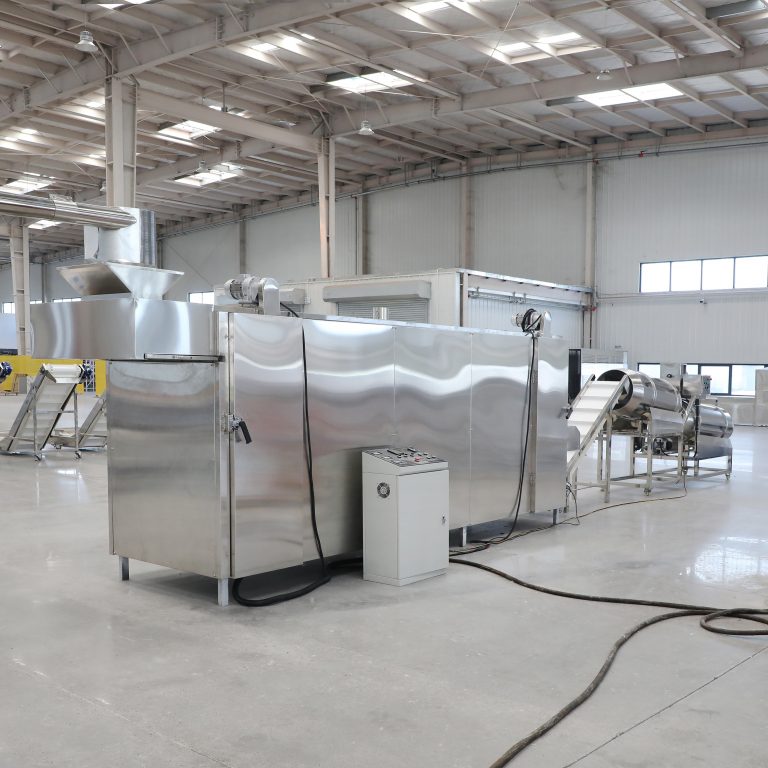
A continuous hot-air dryer normally spreads product across one or more belts while controlled air moves through or around the bed. Heat is supplied by electricity, natural gas, steam or another approved source. Temperature zones, belt speed, layer depth, circulation and moisture exhaust are adjusted to deliver the required final condition.
Hot-air drying is well suited to projects where large amounts of moisture must be removed continuously and the product can tolerate the selected air temperature and residence time. Multi-layer designs can create useful residence time in a compact footprint, but the number of layers is not a capacity guarantee. Effective belt area, airflow distribution, product bed depth and exhaust performance matter together.
For extruded snacks, dry pet food and aquatic feed, the dryer must be balanced with extrusion, cooling, coating and packing. Review the ZEKO industrial food dryer and the food extrusion line capacity-planning guide when comparing a complete process.
How an industrial microwave food dryer works
Microwave heating is volumetric: energy is generated within the material as the electromagnetic field interacts with polar molecules and ions. This can accelerate internal heating and moisture movement compared with relying only on surface heat transfer. A review of microwave-assisted food drying reports shorter drying times for many studied products, but also identifies non-uniform temperature distribution as a central scale-up limitation. See the open research review, Recent applications of microwave technology as novel drying of food.
Installed microwave power is therefore not enough to size a production system. The supplier needs the material composition, particle or piece dimensions, loading depth, moisture profile, bulk density, conveyor loading, residence time and temperature limit. The chamber, belt, field distribution, exhaust and cooling arrangements must be evaluated as one system.
A representative material trial is especially important when the product changes shape, density or dielectric behavior during drying. The test should record more than the final moisture average: it should also examine temperature spread, moisture spread, color, odor, breakage, scorching and the condition after cooling.
Product quality: define a measurable limit
“Better quality” is not an acceptance criterion. The buyer and supplier should agree which attributes matter and how they will be measured. Depending on the product, useful checks can include:
- final moisture average and variation across multiple samples;
- water activity where shelf stability requires it;
- product temperature at dryer discharge and after cooling;
- color difference against an approved reference;
- bulk density, expansion, hardness, rehydration or breakage;
- odor, scorching, surface condition and internal moisture;
- microbiological or thermal-process requirements defined by a qualified process authority.
Published experiments can show what is possible for a specific material, but they are not a performance guarantee for another product. For example, a 2026 study comparing hot-air and vacuum-microwave drying of lemon slices found shorter drying times and different quality outcomes under its tested conditions. The correct lesson is that method, temperature and product geometry interact—not that the same numbers apply to cereal, feed, powder or spices. See the study in Foods.
Compare energy on the same production basis
Machine power and energy consumption are not interchangeable. Installed power shows the maximum connected load; it does not show the energy used per kilogram of saleable product or per kilogram of water removed.
Ask suppliers to separate:
- electricity used by heating, microwave generators, fans, drives, cooling and auxiliaries;
- gas consumption or steam flow and the stated operating condition;
- start-up, standby and normal stable-production periods;
- wet feed, dry output and calculated water removed during the same period;
- acceptable-product yield rather than only gross discharge weight.
A useful comparison indicator is specific energy consumption per kilogram of water removed. If gas, steam and electricity are mixed, convert them using an agreed energy basis and also keep the original utility quantities visible. Energy results from a short empty run or a different product are not directly comparable.
Research on hybrid drying confirms that energy, time and quality can move in different directions depending on product and operating conditions. An experimental study comparing hot-air, microwave and hybrid routes for carrot slices measured drying kinetics, color, shrinkage, rehydration and specific energy consumption together. This is the right evaluation principle for an industrial trial: measure several outcomes, not speed alone. See Abbaspour-Gilandeh et al.
When a combined drying process makes sense
A hybrid process may use hot air for the main water-removal load and microwave energy for a later stage, or use microwave heating early while convective air carries away released moisture. The possible benefit is not “two dryers are better than one.” It is that each stage may operate where it is most effective for the product.
A combined route deserves evaluation when:
- hot-air drying is economical for bulk moisture removal but the falling-rate period is too long;
- internal moisture remains while the surface approaches its temperature or color limit;
- a separate rapid-heating or finishing objective exists after primary drying;
- the higher equipment and control complexity can be justified by product value or throughput.
It is usually a poor choice when the stage boundary is undefined, the product has not been tested, the additional control points cannot be operated consistently, or a correctly sized hot-air system already meets quality and cost targets.
Use a representative pilot test, not a demonstration
A useful drying trial reproduces the intended material and loading as closely as practical. Before the test, write down:
- product name, formula or material description and batch identification;
- piece dimensions, particle-size range, bulk density and loading depth;
- initial moisture basis, target moisture and permitted product temperature;
- target wet-feed rate and expected operating hours;
- test settings: air temperature, airflow, belt speed, microwave power or stage sequence;
- sampling positions and test methods;
- quality limits and the definition of acceptable output.
During the run, record stable operating time separately from warm-up and adjustment. Collect samples across belt width and through time rather than selecting one good sample. Averages can hide hot spots, cold spots or moisture variation.
Factory acceptance criteria for a drying system
| Acceptance area | What should be agreed | Evidence to record |
|---|---|---|
| Capacity basis | Wet feed, inlet moisture, final moisture, saleable output and stable-run duration. | Timed weights, moisture results and rejected-product quantity. |
| Product condition | Temperature, color, texture, breakage, odor and any product-specific limits. | Sampling plan, photos and test results. |
| Uniformity | Allowed variation across belt position and sampling time. | Individual results, not only the average. |
| Utilities | Voltage, electrical load, gas or steam condition, exhaust and cooling requirements. | Meter readings and operating settings. |
| Controls and safety | Start/stop sequence, alarms, interlocks, emergency stops and operator-adjustable settings. | Completed functional checklist and open-item list. |
Use the food production line FAT checklist to define the complete pre-shipment test and the items that must be confirmed later during site acceptance.
Which route fits common ZEKO projects?
Extruded snacks, pet food and fish feed
A continuous hot-air or steam-heated belt dryer is normally the primary choice because it must accept the steady output of the extrusion line and remove a defined moisture load. Microwave may be evaluated for a special finishing or treatment objective, but it should not be added without a product trial and an economic reason.
Spices, herbs, tea, powders and specialty materials
Microwave processing may be attractive when rapid internal heating, color retention, controlled residence time or a defined thermal-treatment objective matters. Material shape, layer depth, dust behavior, temperature sensitivity and exhaust requirements must be tested. A claim of sterilization must be supported by a validated process and agreed test method; the equipment name alone does not prove the result.
Fruit, vegetables, meat and seafood
Product thickness, fat and salt content, structural change, drip, surface heating and the required final texture can change the result substantially. Compare hot-air, microwave and staged routes using representative samples and the intended loading rather than relying on data from a different food.
Information required for a serious dryer quotation
- clear product photos and representative sample information;
- material dimensions, particle size, bulk density and expected loading depth;
- wet feed per hour and planned operating hours;
- initial and target final moisture, with wet-basis or dry-basis stated;
- permitted product temperature and important quality limits;
- whether the objective is drying, heating, enzyme inactivation, sterilization support or a combined process;
- available electricity, gas, steam, cooling water, compressed air and exhaust conditions;
- workshop dimensions, upstream and downstream connection heights;
- required cleaning access, food-contact material and control level;
- sample-test and FAT requirements.
ZEKO can compare a continuous industrial microwave dryer, an industrial hot-air dryer or a staged process after the material, water-removal load, capacity and quality target are defined.
Frequently asked questions
Is a microwave dryer always faster?
No. Microwave heating can shorten processing time for suitable materials and loads, but actual throughput depends on power absorption, loading uniformity, moisture movement, exhaust, temperature limits and cooling. The answer must come from a representative test.
Is hot-air drying always cheaper?
No universal cost answer is reliable. Compare equipment investment, local electricity and fuel prices, water-removal load, acceptable yield, maintenance, labor, start-up losses and annual operating hours on the same product basis.
Can microwave equipment guarantee sterilization?
No equipment label can guarantee a microbiological result. The required organism reduction, sampling method, material condition, time-temperature history and validation responsibility must be defined by the project’s qualified food-safety team.
What is the most important capacity figure?
Use saleable finished-product output at stated inlet and outlet moisture, supported by the calculated water-removal rate. Installed power or wet feed alone is not enough.
What should a buyer send first?
Send product photos, material description, hourly wet-feed target, initial and final moisture, permitted temperature, required process outcome and available utilities. If exact values are not yet known, identify which points require laboratory or pilot testing before final equipment selection.
References and further reading
- FAO: Measurement and moisture-content definitions.
- Recent applications of microwave technology as novel drying of food, Food and Humanity, 2023.
- Ultrasonic-microwave and infrared-assisted convective drying of carrot, Applied Sciences, 2020.
- Hot-air vs vacuum-microwave drying of lemon slices, Foods, 2026.
Planning a drying project? Send ZEKO the material, moisture range, hourly load, temperature limit and factory utilities. We will identify the missing test data and compare a practical equipment route before preparing the proposal.
Continue Reading