Technical Article
Floating Fish Feed Line: Capacity and Pellet Stability
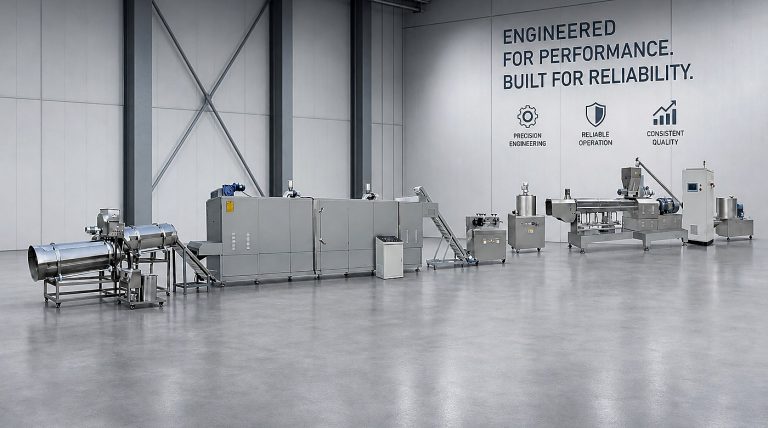
Floating fish feed is often discussed as an “extruder project.” In reality, a stable commercial pellet comes from a connected process: formula preparation, grinding, mixing, conditioning, extrusion, cutting, drying, coating, cooling and packaging must work at compatible capacities.
For a buyer, the key question is not simply “How many kilograms per hour can the extruder produce?” It is: can the complete line repeatedly produce the required pellet size, floatability, water stability, moisture level and saleable output using the agreed formula?
1. Start with the finished pellet, not the machine list
Before comparing equipment, define the product the feed mill needs to make. A practical project brief includes the target species and life stage, floating or sinking requirement, pellet diameters, formula range, target bulk density, water-stability requirement, finished moisture, operating hours, output target and packaging format.
Floating feed normally requires a porous internal structure so that average pellet density remains below water. Formula composition, grinding, moisture, screw configuration, die design and cutting all influence that structure. A formula change can therefore alter the finished pellet even when the extruder settings stay the same.
USDA researchers note that cooking extrusion can create pores that support floating behaviour and later oil absorption. They also identify durability and water stability as essential commercial-quality indicators for aquafeed.
2. A fish feed line is a chain: the slowest section sets real capacity
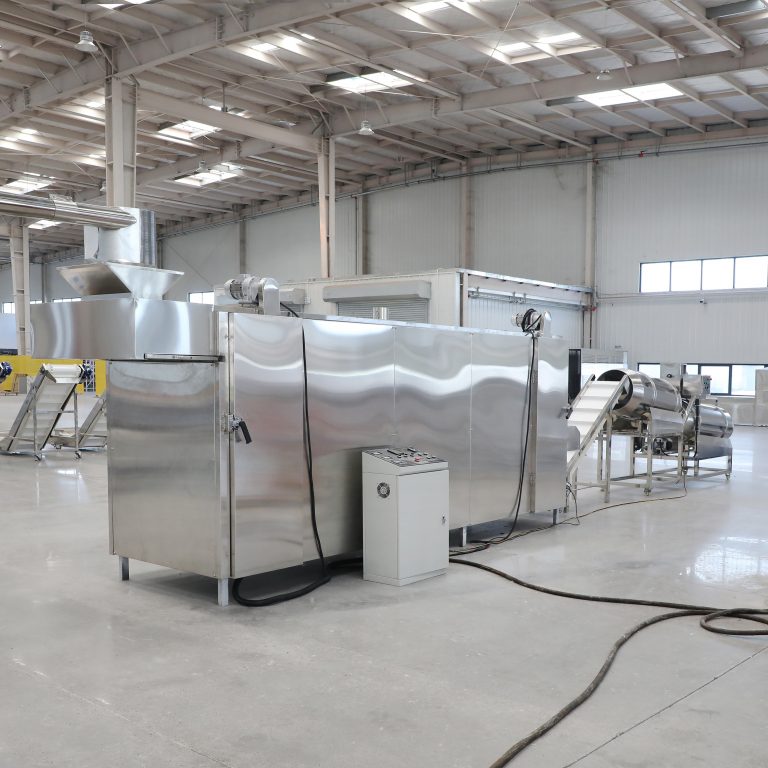
An oversized extruder cannot compensate for an undersized dryer, coater, cooler or packing station. The practical capacity of a line is determined by its limiting section under the target recipe and finished-product specification.
| Process stage | Primary role | Risk when undersized or unstable |
|---|---|---|
| Grinding and batching | Prepare a consistent, accurately dosed blend | Uneven particle size or formula variation makes extrusion unstable |
| Mixing and conditioning | Distribute water, steam and ingredients uniformly | Variable expansion, density and cutting quality |
| Extrusion and cutting | Cook, shape and create pellet structure | Inconsistent floatability, size or surface appearance |
| Drying | Reduce moisture for storage and handling | Soft pellets, mould risk or a hidden capacity bottleneck |
| Coating and cooling | Add oil accurately and stabilise product | Uneven oil, sticky product or damage before packing |
| Packaging | Deliver saleable finished goods | Finished product accumulates and continuous production stops |
When reviewing a proposal, ask the supplier to identify the continuous bottleneck capacity, not only the nominal capacity of the extruder. Capacity should be stated for a defined formula, pellet diameter, moisture condition and operating mode.
3. Moisture control is where capacity becomes real
Extrusion and drying must be planned together. The dryer is not simply equipment placed after the extruder: it determines whether wet pellets can be converted into a stable finished product without slowing the line.
Water removed per hour = wet feed rate x (initial moisture – final moisture) / (1 – final moisture)
For example, if 1,000 kg/h of wet pellets enter the dryer at 24% moisture and the finished target is 10%, the dryer must remove about 156 kg of water per hour. This is a planning example, not a universal design figure. Actual dryer selection also depends on the formula, pellet size, residence time, recirculation, ambient conditions and required operating margin.
Ask the supplier to document wet output entering the dryer, moisture before and after drying, calculated evaporation rate, residence time, heat source, expected energy use, cooling temperature and the way capacity changes across pellet sizes and formulas. FAO guidance notes that dry feed is commonly stored around 10-12% moisture, and that excessive pellet-size variation can indicate processing problems affecting technical performance.
4. Define pellet quality with measurable acceptance criteria
“High-quality floating feed” is not an acceptance standard. Buyers should agree measurable product criteria before commissioning, then use the same method during factory acceptance and site commissioning.
- Pellet diameter and length: verify the agreed dimensional range.
- Bulk density: a key reference for floating or sinking behaviour.
- Floatability: record the agreed test method and observation time.
- Water stability: observe disintegration and fines after the agreed immersion period.
- Pellet durability: confirm that pellets withstand conveying, bagging and normal handling.
- Finished moisture: test at dryer discharge and before packing.
- Oil application: compare actual post-coating oil level with the target.
Research from the USDA Agricultural Research Service found that extruded feed can have higher starch gelatinisation, water stability and physical durability than conventionally compressed feed. That does not mean every formula will perform identically; it means the production conditions must be demonstrated with the buyer’s representative recipe.
5. Formula and processing settings must be developed together
A line supplier provides equipment and process support, but no machine eliminates the need for formula development. Ingredient characteristics affect expansion, density, texture, water stability and oil absorption. Higher oil levels, high-fibre raw materials, different starch sources and protein-rich formulas can all change extrusion behaviour.
During trials, the production team may need to adjust grinding fineness, conditioning moisture and temperature, screw configuration, screw speed, barrel temperature profile, die open area, knife speed, drying time and coating rate. This is normal engineering work, not evidence that a complete line has failed.
The right objective is a documented operating window: a repeatable relationship between formula, product specification and process settings. This is especially important when one factory intends to produce multiple pellet sizes or both floating and sinking products.
For core process equipment, see ZEKO’s twin-screw food extruder and industrial drying system pages.
6. What a useful factory acceptance test should prove
A factory acceptance test should be a controlled production run, not a short machine demonstration. It should use an agreed representative formula and record the conditions under which the line was proven.
- Run the complete line continuously for an agreed period.
- Use the agreed formula and pellet diameter or diameters.
- Record wet and finished capacity at the same operating conditions.
- Sample pellet size, moisture, floatability and water stability.
- Inspect coating, cooling and product condition after conveying.
- Check electrical cabinets, safety devices and normal operating controls.
- Train operators on start-up, shut-down and routine adjustments.
- Record open items, spare parts and documentation before shipment.
The value of a factory acceptance test is not only quality control. It removes ambiguity. Both buyer and supplier should leave with the same evidence of what the line demonstrated, the formula and settings used, and the items that still require adjustment after installation.
7. Questions to answer before requesting a quotation
- Target species, life stage and pellet application
- Floating, slow-sinking or sinking feed requirement
- Formula range and key ingredients
- Pellet sizes and target daily and annual output
- Required finished moisture and storage conditions
- Available electricity, steam, gas, compressed air and water
- Oil-coating target and packaging format
- Factory layout limits and cleaning requirements
- Acceptance tests that must be demonstrated before shipment
A useful quotation answers these questions with a process-based solution rather than a disconnected list of machines. For a line scope that includes extrusion, drying, cooling and packaging, review ZEKO’s food processing solutions or submit the product and capacity details through the project proposal form.
Conclusion
A floating fish feed project succeeds when capacity, pellet quality and operating conditions are defined together. The extruder is central, but it is not the whole production line. Grinding, conditioning, drying, coating, cooling and packaging all influence the finished pellet and the output that can actually be sold.
Before selecting equipment, define the product specification, formula range, utilities, acceptance criteria and practical operating target. This makes quotations easier to compare, commissioning more predictable and future expansion less costly.
Technical references
Continue Reading