Technical Article
How to Size a Snack Drying Oven After Extrusion
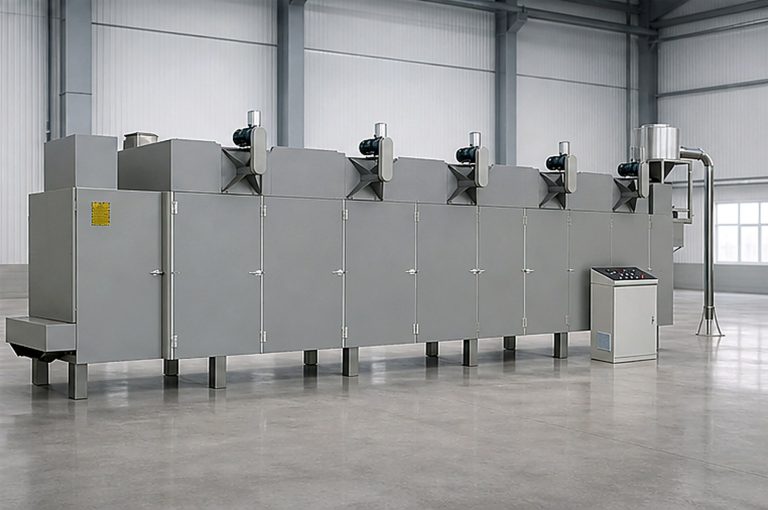
For an expanded snack line, the drying oven is not simply a machine placed after the extruder. It is the stage that stabilizes the open structure created at the die and brings the product to a moisture condition that can survive seasoning, cooling, packing and transport. An extruder may produce a good-looking corn puff at discharge, but an undersized or poorly balanced dryer can still leave the factory with soft texture, breakage, inconsistent seasoning pickup or short shelf life.
That is why a drying oven should be selected from the real product process, not from belt length or a nominal hourly figure alone. The key questions are how much water must be removed, how long the product needs under controlled air, how evenly air reaches the product bed, and how the dryer is matched to the extruder and downstream equipment.
1. Start with the product leaving the extruder
The dryer sees the product as it actually leaves the extruder, not as it appears in a sales specification. Its incoming condition depends on formula moisture, extrusion cooking, die design, product shape, expansion ratio, cut length and the rate of production. A dense ring, a light curl and a filled snack can require very different drying behavior even when they are made on the same extruder platform.
The first task is to define the product specification: target texture, piece size, bulk density, inlet moisture condition, final moisture target, final temperature before packing and realistic saleable output. Without these inputs, a dryer can be sized around a machine nameplate while the actual product bed becomes too deep, too wet or too crowded for stable drying.
2. Calculate water removal before choosing a dryer size
A useful dryer discussion starts with a simple mass balance. The production team needs to compare the product mass entering the dryer, its incoming moisture, its desired final moisture and the planned saleable output. The difference is the water that the dryer must remove continuously under normal operation.
This is more meaningful than asking only for a dryer rated at a certain kilograms-per-hour figure. A line producing 300 kg/h of finished puffs does not necessarily send 300 kg/h into the dryer. The wet product mass is higher, and the water-removal load changes when the formula, shape, expansion level or inlet moisture changes. A serious proposal should state which material condition and final target the quoted capacity is based on.
For new projects, the practical approach is to define a normal production condition and a reasonable operating range. The dryer should be able to maintain the target product quality across that range, rather than perform only during a short trial with one favorable recipe.
3. Residence time is controlled by the full drying path
Residence time is the period each piece remains in the drying environment. It is influenced by effective belt length, number of belt layers, belt speed, product distribution and the amount of product loaded onto the belt. A longer oven does not automatically create better drying if the product is piled too deeply, travels unevenly or receives unbalanced airflow.
For expanded snacks, even distribution is especially important. When product forms a heavy bed, air cannot reach every piece equally. The top layer may dry quickly while the lower layer remains warm or soft. The result can be variation in crispness, breakage during seasoning and inconsistent moisture after packing.
During project planning, the supplier and factory should agree on the normal product bed depth, conveyor loading method and expected speed range. These details connect the theoretical residence time to the real product condition.
4. Airflow and exhaust determine drying uniformity
Drying removes moisture only when heat reaches the product and the moist air is then removed from the oven. This requires a controlled relationship between circulating air, air temperature, exhaust volume, fresh-air intake and the product bed. A high temperature setting alone cannot compensate for weak air distribution or insufficient moisture removal.
A well-designed industrial oven uses circulation zones to bring conditioned air through the product layer as evenly as possible. The exhaust system removes humid air so that the drying environment does not become saturated. The correct balance depends on product shape, oil content, surface area, belt loading and the required final texture.
If air is too aggressive for a fragile product, surface damage and breakage can increase. If airflow is too weak or uneven, the product may leave the oven with hidden moisture differences. The goal is not the highest possible temperature. It is a repeatable product condition at the planned output.
5. Match oven zones to the product’s drying behavior
Expanded products are usually most vulnerable immediately after extrusion. Their structure is still hot and open, and rapid handling can damage the shape before the product has stabilized. A multi-zone oven allows the process to be adjusted along the product path: an initial stage for controlled moisture removal, a middle stage for continued drying and a later stage that prepares the product for seasoning, cooling or packing.
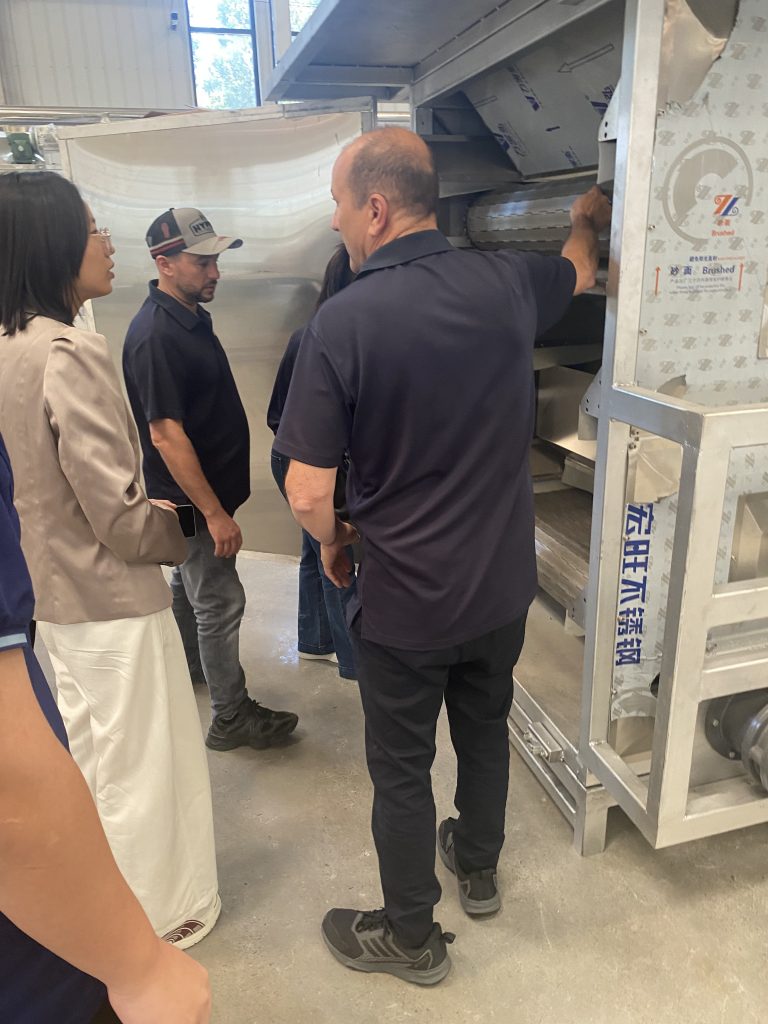
The exact temperature profile, airflow and residence time must be established through product trials. They should not be copied from a different snack, formula or factory. The valuable part of a factory acceptance test is not simply seeing the conveyor run; it is proving that the agreed product can reach the target moisture, texture and appearance at a stable output.
6. The dryer must be balanced with the extruder and downstream line
An oven is part of a complete system. If the extruder output rises, the dryer loading changes. If dryer discharge is too hot or too moist, seasoning adhesion and cooling behavior change. If the cooling conveyor cannot remove residual heat before packing, crispness can decline inside the bag even when the oven itself performed correctly.
For this reason, a complete puffed snack production line should be designed around one consistent practical capacity. The mixer, feeder, extruder, air conveyor, dryer, seasoning drum, cooling section and optional packing machine each need enough operating margin for the same product route.
For a non-fried route, our hot-air expanded snack process guide explains why extrusion, drying capacity and factory utilities must be considered together before a quotation is compared.
7. What to confirm before requesting an oven proposal
- Finished snack type, reference photos, dimensions and expected texture
- Formula type and known inlet or target moisture conditions
- Required saleable output per hour, not only extruder nameplate capacity
- Product loading, belt distribution and expected residence-time range
- Available heat source, voltage, factory space and exhaust route
- Downstream seasoning, cooling and packing arrangement
- Acceptance measurements for moisture, appearance, breakage, texture and output
These details make it possible to compare proposals on process suitability rather than on oven length or price alone.
Conclusion
A snack drying oven protects the value created by the upstream extrusion process. Its capacity is defined by water removal, residence time, airflow, product distribution and integration with seasoning and cooling. When these conditions are agreed before equipment selection, the factory is more likely to receive stable crispness and saleable output instead of an oven that is only adequate on paper.
If you are planning an expanded snack project, send ZEKO your target product, capacity, formula information, available utilities and workshop conditions. We can help match the extrusion, drying and downstream equipment scope to the real production process.
Continue Reading