Technical Article
Twin-Screw Food Extruder: Stand-Alone Machine or Complete Production Line?
When a buyer asks for a twin-screw food extruder quotation, the first decision is not the screw diameter or motor power. It is the project boundary. Is the requirement a stand-alone extrusion machine that will connect to existing equipment, or a complete production line with one supplier responsible for the process interfaces?
This choice changes more than the quotation total. It affects commissioning risk, the meaning of the stated capacity, utility requirements, product consistency and who is responsible when one part of the line limits the output. The practical goal is not to buy the largest possible machine; it is to define a scope that can repeatedly make saleable product under agreed conditions.
The project boundary comes before the machine model
A twin-screw extruder is a powerful process unit, but it does not operate in isolation. The material must arrive in a stable condition; the extrudate must be cut, dried, cooled, seasoned or packed without becoming the new bottleneck. A proposal that only lists an extruder can be technically correct while still leaving critical interfaces undefined.
Before comparing models, write down which party owns each step from raw-material receiving to packed product. That document becomes the common basis for every supplier proposal.
When a stand-alone twin-screw food extruder is the right scope
A stand-alone machine can be the efficient choice when a factory already has proven upstream and downstream equipment, an experienced process team and clear mechanical, electrical and control interfaces. It is normally suitable when all of the following are true:
- the existing feeder, mixer and conveying system can supply a consistent recipe, moisture level and feed rate;
- the existing dryer, cooler or other downstream equipment has verified spare capacity for the intended product;
- space, floor loading, utilities, safety guarding and access have been checked against the proposed machine;
- the buyer can define the handover points, including communication signals and product transfer equipment; and
- one internal team can coordinate installation, start-up and troubleshooting across multiple suppliers.
In this situation, the quotation should still state what is included at both ends of the machine: feeding connection, die and cutter arrangement, discharge point, controls, commissioning assistance, spare parts and training. “Extruder only” is not a sufficiently detailed scope description.
What a complete extrusion line normally includes
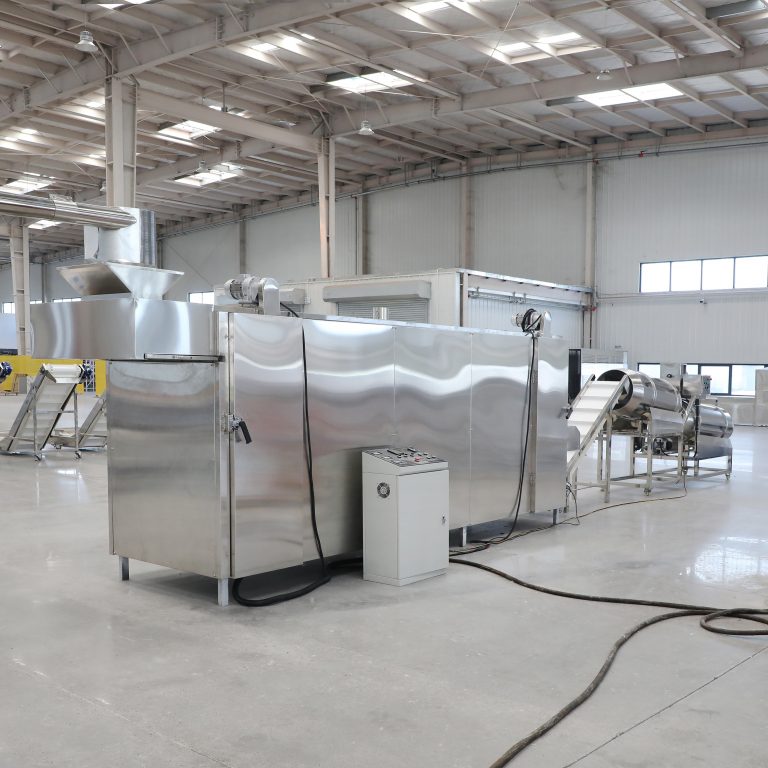
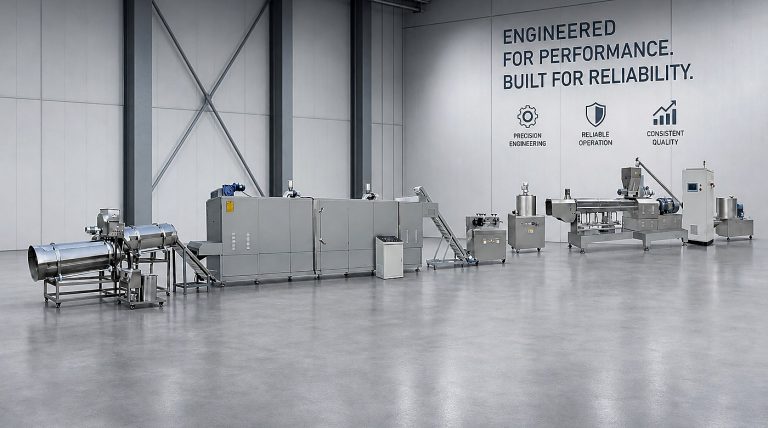
A complete line gives one supplier responsibility for the interfaces that most often create delays. The final layout depends on the product, but a typical food extrusion project can include:
- raw-material dosing, mixing and preconditioning;
- feeding and conveying into the twin-screw extruder;
- die, cutting and product transfer;
- drying, cooling and, where required, seasoning or coating;
- inspection, conveying and handover to packaging; and
- electrical controls, safety interlocks and defined commissioning support.
For puffed snacks, the relationship between extrusion, drying and seasoning is especially important. For pet food or aquatic feed, recipe conditioning, density control and drying/cooling stability usually deserve equal attention. The right line is therefore selected around the finished product, not around a generic equipment list.
Seven interfaces to define before asking for proposals
1. Product and raw-material condition
Give suppliers the target product shape, density or expansion expectation, moisture target, ingredient range and any sensitive ingredients. If the formula is confidential, a functional description and representative material data are still better than a vague request for “snacks” or “feed.”
2. Capacity as saleable output
Ask for capacity on a clear basis: product type, moisture basis, recipe, operating hours and expected yield. A nameplate throughput at the extruder inlet does not automatically equal packed product output. Use a saleable-output capacity plan to compare every section of the line on the same basis.
3. Upstream supply
Clarify who provides batching, mixing, storage and feeding. Powder bridging, inconsistent dosing or poor moisture control can look like an extruder problem even when the root cause is upstream.
4. Downstream drying, cooling and packing
State the required residual moisture, cooling temperature, seasoning step and packing handover rate. A fast extruder paired with an undersized dryer or unstable cooler cannot deliver the promised daily output.
5. Factory utilities and site constraints
Confirm available electricity, water, steam, gas, compressed air, extraction, drainage, ceiling height, access route and local safety requirements. These items are not accessories; they determine whether a proposal can be installed without major changes.
6. Controls and ownership of the interfaces
Define whether each machine has independent controls or one coordinated line control system, and who provides emergency-stop circuits, interlocks, installation drawings and cable/pipe connection points.
7. Commissioning and acceptance criteria
Agree in advance how performance will be demonstrated. Useful criteria include stable run time, target output on the agreed recipe, visual product quality, moisture range, safety checks, documentation and a list of open items. Our Factory Acceptance Test checklist can be used as a starting point.
How to compare two proposals fairly
Do not compare only the bottom-line price. Build a simple scope matrix with the same rows for every supplier: product basis, capacity basis, equipment included, utility consumption, line controls, installation boundary, commissioning days, training, spares, warranty and acceptance test. Any blank cell is a cost or schedule risk that should be clarified before an order is placed.
This is particularly valuable when one proposal is for an extruder package and another is for a complete line. The lower initial number may simply exclude drying, conveying, controls or on-site work that the factory will still need to arrange.
Use the product route to define the equipment route
For a puffed snack project, start with the puffed snack production line and its required texture, seasoning and packing method. For kibble, review the pet food extrusion line; for aquatic feed, use the fish feed production line as the product-specific starting point. The twin-screw extruder should then be specified as part of that route.
Information to send when requesting a project proposal
A useful first enquiry contains the product photos or samples, ingredient description, desired capacity, target market, available utilities, factory dimensions, preferred packaging handover point and whether the request is for a stand-alone machine or a complete line. If some information is not final, identify it as an assumption rather than leaving it unstated.
That level of definition lets suppliers prepare proposals that are comparable and technically useful. If you are still deciding where the boundary should sit, send us the available project information; we can help define the process scope before a final equipment configuration is selected.
Continue Reading