Technical Article
Why Puffed Snacks Collapse After Extrusion: Process Control Guide
A puffed snack that looks correct at the die can still become a commercial problem ten minutes later. It may shrink, soften, crack during conveying, lose its open cell structure or become inconsistent from one production hour to the next.
These defects are often described as poor expansion. That description is too broad to solve the problem. The final texture is created by a chain of events: the formulation absorbs water, the extruder cooks and shears the mass, pressure develops before the die, moisture flashes off at discharge, and the fragile structure must then survive drying, seasoning, cooling and packing.
For a factory owner, this matters because a line can run mechanically while still producing excessive waste, unstable bulk density or complaints from the packing department. The goal is not the highest visible expansion at any moment. The goal is repeatable, saleable texture at the planned output.
1. What expansion actually means at the die
Inside an extrusion barrel, starch-based material is mixed with water, heated and worked by the screws. Under the combined effect of heat, pressure and mechanical shear, the material becomes a hot, pressurized melt-like mass. When it exits the die, pressure drops rapidly. Part of the water converts to vapour, creating cells that expand the product.
The die is therefore not a decorative final part. It is a controlled pressure-release point. Product moisture, barrel temperature, screw configuration, feed consistency, die opening and cutting conditions all influence what happens in the first seconds after discharge.
When the process is balanced, the product forms a stable cellular structure. When it is not, the cells can be too small, too uneven or too weak to survive downstream handling. A product can look large at discharge and still collapse because its internal structure did not set correctly.
2. Raw-material condition is the first control point
Many extruder problems start before material reaches the hopper. The same recipe can behave differently when flour particle size, starch condition, protein level, fibre content or incoming moisture changes. Material that has absorbed moisture during storage may need a different water addition than the same formulation received in a dry season.
For puffed snacks, moisture is especially important. Too much moisture can reduce the pressure-driven flash expansion at the die. Too little moisture may make feeding unstable, increase mechanical load and create a product that is brittle or difficult to control. There is no universal moisture number that fits every cereal, shape and formula. The operating range must be established for the specific product.
Factory teams should record at least:
- incoming raw-material moisture and storage condition;
- particle-size consistency after grinding or sieving;
- actual water addition, not only the recipe target;
- premixing time and hold time before extrusion;
- the ratio of starch, protein, fibre, sugar and other functional ingredients.
For formulations using wheat, rye, triticale or freekeh, see our puffed grain production guide for the material decisions that should be validated before commercial capacity is promised.
Without this record, operators tend to adjust barrel temperature or screw speed to compensate for a raw-material change. That can temporarily restore appearance while hiding the real cause.
3. The extruder creates the process window
The extruder does more than push material forward. Its screws, barrel zones and restrictions create the thermal and mechanical energy that prepares the material for expansion. In practice, the operator is managing a process window rather than a single setting.
Feed rate affects fill level and residence time. Screw speed changes conveying, mixing and shear. Barrel temperatures influence cooking and viscosity. The screw configuration determines how strongly material is mixed, compressed or kneaded before it reaches the die.
These controls interact. For example, increasing screw speed may increase shear and output, but it can also reduce residence time or change pressure at the die. Raising a temperature zone may help cooking in one formulation but create stickiness or unstable cutting in another. A correct setting cannot be copied blindly from a different product.
This is why a serious production line needs visible, repeatable control of feeder rate, water addition, screw speed, barrel temperatures and process load. It is also why a factory acceptance test should use agreed raw materials and run long enough to show stable conditions rather than a short demonstration.
4. Die design and cutting determine how the product leaves the line
Die geometry affects pressure, velocity and the shape of the extrudate. A small change in opening size, land length or die condition can change expansion and surface appearance. Wear, partial blockage and poor cleaning can create uneven pressure between openings, producing inconsistent pieces across the same batch.
Cutting is another underestimated variable. If the cutter speed is not matched to extrudate velocity, the product length changes and the cut edge can be compressed or torn. For light expanded products, rough cutting may create fines that become seasoning waste and reduce the yield reaching the packer.
A practical routine should therefore include die inspection, documented cutter settings, replacement criteria for worn parts and a sample check across multiple die openings. Do not judge line performance from only the best-looking piece.
5. Drying, seasoning and cooling can either preserve or damage the texture
Expansion is not finished at the die. The open structure must be stabilized before it is exposed to seasoning, conveyors and packaging. If the product enters a dryer too wet, too hot or too crowded, the structure can soften or deform. If it is overdried, breakage can increase. If it is packed before it has cooled sufficiently, residual heat and moisture can reduce crispness inside the bag.
Seasoning also has a process effect. Oil application, powder dosage, drum residence time and product temperature must be balanced. Heavy seasoning on a weak product can increase breakage. Poor distribution may lead the production team to add more powder, creating inconsistent taste without solving coverage.
When a snack collapses after it looks acceptable at the die, observe where the defect first appears: at the dryer discharge, in the seasoning drum, on a transfer conveyor or after packing. That location narrows the investigation much faster than changing every upstream setting.
6. A structured troubleshooting sequence
When texture changes, avoid changing five controls at once. Use a sequence that protects production data:
- Confirm the symptom: measure bulk density, dimensions, moisture, breakage and appearance from several points in the run.
- Check raw materials: compare incoming moisture, grinding, preconditioning and water addition with the last stable batch.
- Review the extrusion record: feeder rate, screw speed, temperatures, pressure indicators and process load should be reviewed together.
- Inspect die and cutting: verify opening condition, cleanliness, product length and cutting quality.
- Trace the downstream route: inspect drying, cooling, seasoning and conveying at the point where texture first changes.
- Test one controlled adjustment: document the result before changing the next variable.
This approach may feel slower than asking an operator to turn it up, but it reduces repeated waste and creates a usable operating standard for the next shift.
7. What equipment scope supports stable puffed snacks
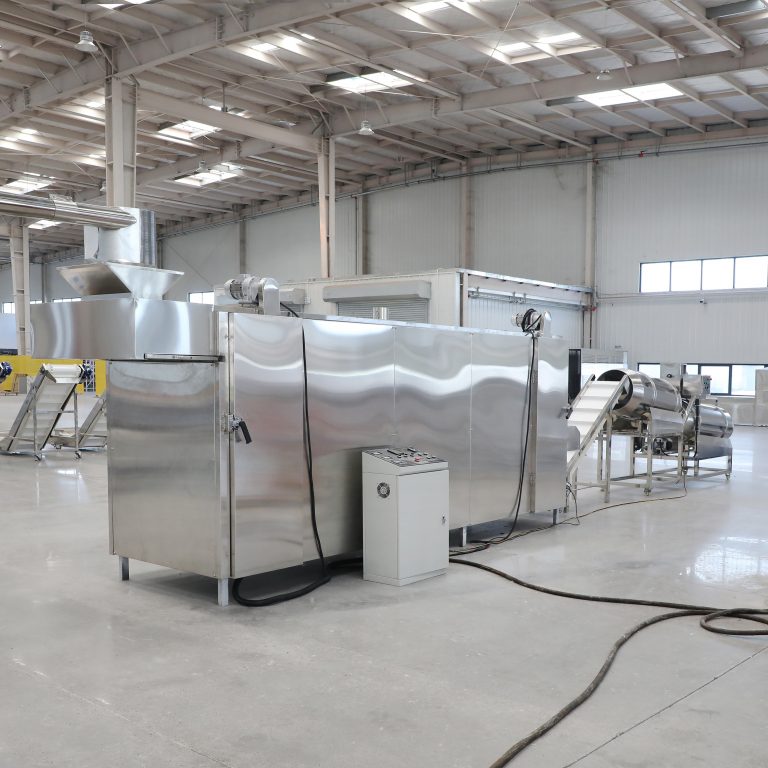
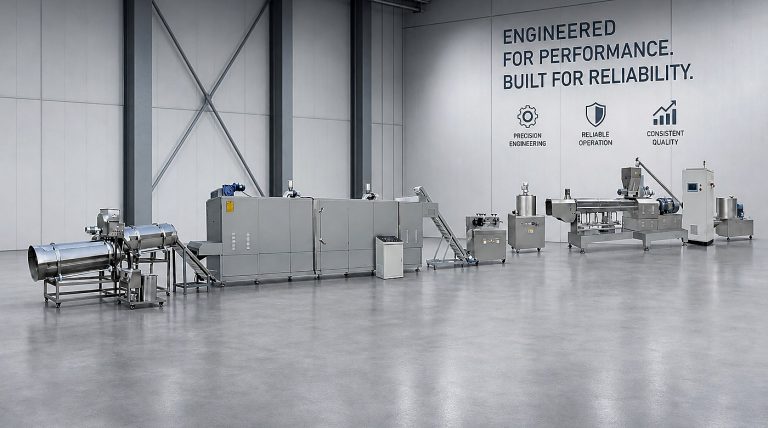
A stable puffed-snack process is a system, not an extruder alone. Depending on the product, the scope may include raw-material handling, grinding, dosing, preconditioning, a twin-screw food extruder, die and cutting system, drying or baking, seasoning, cooling, metal detection and packaging.
The correct scope depends on the product route, target capacity and local factory conditions. A plant that plans only for the extruder may later discover that drying, cooling or packaging has become the real bottleneck. For an overview of the full route, see our puffed snack production process and equipment guide.
If you are comparing a core machine with a complete line, our puffed snack production line page explains the main equipment stages. For owner-level planning before quotation comparison, use the puffed snack project entry guide.
Conclusion
Puffed-snack texture is the visible result of an invisible process balance. Raw-material condition, moisture, mechanical energy, die pressure release, drying, seasoning and cooling all contribute to the final product. The most reliable factories do not rely on a single best setting. They define the product specification, record the process window and investigate defects in a controlled order.
If you are planning a new line or troubleshooting unstable expansion, send ZEKO your product, capacity and factory details. A useful line proposal begins with the process conditions that make saleable product possible.
Continue Reading