Technical Article
Food Production Line Factory Acceptance Test (FAT): A Practical Checklist for Buyers
For a food factory, a production line is not truly accepted because motors turn or a short demonstration looks satisfactory. The critical question is whether the supplied system can run the agreed product, at an agreed stable rate, with controllable quality, safe operation and the documents needed to operate it after shipment.
This practical guide explains how factory owners, project managers and purchasing teams can prepare a useful Factory Acceptance Test (FAT) for a food processing line. It applies to extrusion, drying, cereal, snack, powder and packaging projects. The purpose is not to create unnecessary paperwork; it is to reduce uncertainty before equipment leaves the supplier’s factory.
FAT and SAT Solve Different Risks
A Factory Acceptance Test takes place at the equipment supplier’s factory before shipment. It is the opportunity to verify assembly quality, basic operation, controls, safety functions and—where the agreed scope permits—the line’s performance with a representative product or material.
A Site Acceptance Test (SAT) takes place after installation in the buyer’s factory. It confirms that the line works correctly with the actual site utilities, workshop layout, operators and production conditions. A successful FAT reduces site risk, but it does not replace site commissioning. The two tests should be planned together so that neither party assumes a result from one stage proves the other.
Begin With an Acceptance Protocol, Not a Verbal Promise
The strongest FAT starts before manufacturing is complete. Buyer and supplier should agree a short written protocol that states what will be tested, who will attend, the data to be recorded and what counts as pass, conditional pass or open item. If the acceptance standard is only “machine running normally,” disagreements are likely when the project is nearly ready to ship.
At minimum, the protocol should define:
- The specific product or representative material to be used, including important formula or moisture assumptions.
- The intended line configuration and the equipment included in the FAT scope.
- The capacity basis: kilograms per hour, packs per minute or another agreed measure.
- The required stable-running duration and whether start-up material is excluded from the calculation.
- Critical product criteria such as dimensions, moisture, appearance, breakage or pack weight.
- Which utilities are simulated at the supplier’s factory and which must be verified only at site.
- The method for recording defects, stops, adjustments and unresolved items.
For an extrusion line, it is especially important to distinguish an equipment trial from formula development. The line can be demonstrated around a defined process target, while final recipe approval remains dependent on the buyer’s ingredients, product standard and market requirements.
Define Capacity in a Way That Can Be Measured
Headline capacity is often misunderstood. A buyer should ask whether the number refers to the extruder output, wet product, finished product, theoretical maximum or saleable output after normal quality losses. A useful FAT capacity target states the product condition, the measurement point and the time period.
For example, a meaningful statement may be: “Measure finished, cooled product over the agreed stable production period, after normal start-up adjustments, with the line configured as supplied.” The exact wording will change with the project, but the principle is the same: both teams must be measuring the same thing.
Where drying, toasting, cooling or packing is included, verify that these sections can accept the proposed processing rate. A high-output upstream machine does not create a high-output line if the dryer, cooler or packer is the practical bottleneck.
Test the Complete Product Path
Food machinery is a connected system. During FAT, inspect not only individual equipment but the product path from feeding to discharge. Watch for uncontrolled drops, material build-up, difficult cleaning points, transfer instability, damaged product, powder leakage or places where an operator must intervene repeatedly.
- Feeding and dosing: confirm stable material delivery and that feeders, conveyors and weighing or dosing devices match the actual material behavior.
- Processing: check that temperature, screw speed, roller gap, air flow or other agreed process parameters can be displayed and adjusted as intended.
- Product transfer: check that conveyors, chutes and buffers move product without excessive breakage, blockage or carryover.
- Drying, cooling and finishing: assess whether residence time and controls support the specified final moisture, color, texture or handling requirement.
- Packaging connection: where included, confirm that the processing line and packaging section can operate together without forcing avoidable stops.
Verify Quality Stability, Not Only One Good Sample
A single good sample is helpful, but it cannot demonstrate a stable process. Ask for data or observations across an agreed run period. For a snack or cereal line, this may include product dimensions, appearance, bulk density, moisture, fines or breakage. For packaging, it may include net weight, seal appearance, bag handling and reject function.
The aim is not to demand laboratory-level validation from every machinery project. It is to identify visible instability before shipment: drifting product shape, rising breakage, temperature variation, inconsistent feeding or repeated manual correction. Any process result should be understood in the context of the material used during FAT.
Check Safety, Cleanability and Operator Access
Before shipment, inspect guards, emergency stops, electrical cabinets, access doors, hot surfaces and moving parts. The buyer should also walk around the line as an operator and maintenance technician would: Can product-contact areas be reached for cleaning? Can a hopper or chute be opened safely? Is there room to change film, remove a screen, inspect a die or service a motor?
Hygienic design is not only a material specification. It includes cleanable surfaces, accessible joints, avoidance of unnecessary product traps and an arrangement that the actual factory team can inspect and maintain. The required standard depends on the product and destination market, so project-specific hygiene and compliance needs should be defined before FAT.
Test Controls, Interlocks and Useful Data
Confirm that the control system is more than a collection of screens. Test start and stop sequence, emergency stop behavior, alarms, temperature or speed readouts, interlocks and the recovery procedure after an interruption. Ask which values can be adjusted by the operator, which values are protected and how settings will be documented for repeat production.
If remote support, data logging or production reporting is part of the scope, document exactly what is supplied and how it will be used. A control system should help the factory identify normal operating conditions and abnormal events—not merely display a machine status.
Finish FAT With Documents and an Open-Item List
FAT should end with a clear record rather than a general statement that everyone was satisfied. The delivery file normally needs the agreed equipment list, electrical information, operating and maintenance documents, recommended spare parts, drawings or layout information as applicable, and the FAT record itself.
If a point cannot be fully tested at the supplier’s factory, record it as an open item with an owner and a target verification stage. Examples can include final testing with buyer-supplied packaging film, site utility confirmation, product trials with the buyer’s local ingredients or downstream equipment integration. A transparent punch list is healthier for a project than an unresolved verbal promise.
Practical FAT Checklist for Food Processing Lines
- Confirmed FAT protocol, product basis and attendees
- Verified equipment scope against the approved configuration
- Recorded capacity basis and stable run duration
- Observed product quality and transfer across the complete line
- Checked major process controls, alarms, guards and emergency stops
- Reviewed cleaning access, maintenance access and operator workflow
- Verified included utilities, electrical documents and spare-parts list
- Recorded deviations, open items, owner and SAT follow-up action
A well-prepared FAT makes a project more predictable for both sides. It does not guarantee that every product variation will be solved before shipment, but it makes the remaining work visible and gives the site team a far better starting point for commissioning.
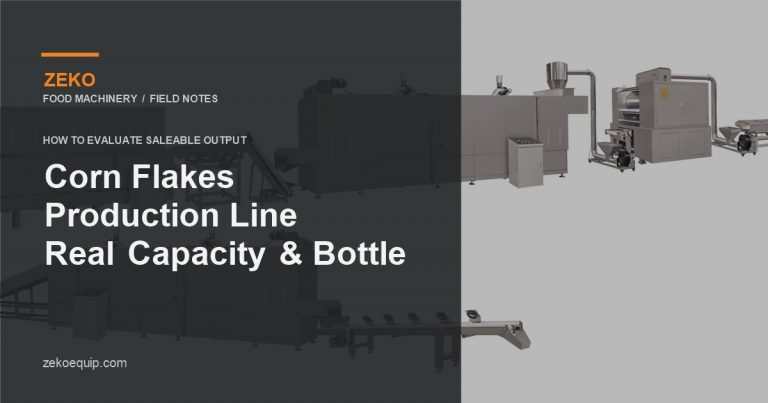
When preparing a machinery request, use our food machinery quotation checklist to organize the product, capacity, utility and workshop information. You can also review ZEKO’s puffed snack production line, corn flakes production line and automatic food packaging machine solutions.
Frequently Asked Questions
Can FAT guarantee the final product after installation?
No. FAT verifies the agreed equipment configuration and pre-shipment performance under the conditions available at the supplier’s factory. Final product approval also depends on site utilities, local ingredients, operators, workshop conditions and the agreed commissioning scope.
Should buyers send their own raw materials for FAT?
Where practical, buyer-supplied material can make the test more representative. If this is not possible, the FAT record should state the substitute material and the limits of the result.
What happens if an item is not complete during FAT?
It should be written into an open-item list with the required action, responsible party and planned verification stage. Some items can be resolved before shipment; others may be verified during site installation and SAT.
Planning a food machinery project? Send ZEKO your product, capacity and factory conditions to discuss a suitable process and project acceptance scope.
Plan your next step
Looking for a practical equipment solution?
Discuss your FAT plan and target capacity. Our team can help you compare configurations and prepare a suitable solution.
Continue Reading