Technical Article
Puffed Grain Production Line: Wheat, Rye, Triticale & Freekeh
A puffed grain production line can turn corn, rice, wheat and selected alternative grains into directly expanded snacks, cereal shapes and other crisp products. However, a machine should not be selected from the grain name alone. The commercial result depends on the flour specification, grain percentage, starch and fibre balance, target shape, expansion, seasoning, saleable output and packaging format.
This guide focuses on four materials that buyers increasingly ask about—wheat, rye, triticale and freekeh—and explains which product decisions must be confirmed before a complete extrusion line is quoted.
Which grains can be used for puffed products?
Common projects use corn flour, rice flour, wheat flour and starch. Product developers also investigate quinoa, rye, buckwheat, sorghum, brown rice, spelt, teff, fonio, triticale, freekeh and multigrain blends.
These materials do not behave identically in an extruder. Starch type, protein, fibre, fat, particle size and water-binding behaviour all change the way the material cooks and expands. A formula that runs well with refined corn flour cannot simply be replaced kilogram-for-kilogram with a wholegrain or roasted grain flour. The product should be tested before a commercial capacity is promised.
How wheat, rye, triticale and freekeh differ in extrusion
| Grain | What the buyer must define | Likely development focus |
|---|---|---|
| Wheat | Refined or whole wheat, bran level, finished shape and texture | Balance expansion with fibre and protein; confirm flour particle size and moisture |
| Rye | Rye percentage, blend base, wholegrain claim and flavour target | Manage higher fibre and water binding through formulation and process trials |
| Triticale | Actual flour analysis, cultivar or supplier, grain percentage and target density | Treat it as its own raw material rather than assuming wheat settings will transfer |
| Freekeh | Roasting level, milling specification, inclusion rate and desired smoky flavour | Account for the grain’s prior roasting and drying; validate milling, blending and extrusion response |
The table is a development starting point, not a universal recipe. Research on expanded snacks consistently shows that formulation and process conditions interact: feed moisture, barrel temperature, screw speed, die geometry and raw-material composition affect expansion, density and texture. That is why a reliable proposal begins with the target product rather than a standard machine list.
How are puffed wheat products manufactured?
Wheat flour is mixed with the remaining dry ingredients, fed at a controlled rate, cooked under heat and mechanical shear, shaped through a die and cut. The pieces then pass through drying, seasoning, cooling and packaging. Refined wheat and whole wheat are not interchangeable from a product-development perspective. Added bran can make a denser product and reduce expansion, so the wholegrain percentage and texture target should be discussed together.
What changes for rye puffs manufacturing?
Rye can be used in cereal and snack concepts, but the buyer should state whether rye is the main grain, a label claim or one component of a blend. Its fibre profile and water-binding behaviour can change melt flow and final texture. Instead of promising that one standard setting will work, ZEKO recommends trials covering rye percentage, supporting starch, feed moisture, die shape and dryer conditions.
Why must triticale puffs manufacturing be tested?
Triticale is a wheat–rye hybrid, but it should not be treated as a generic substitute for either grain. Published work on triticale extrudates shows that process moisture and extrusion temperature affect expansion, density, hardness and storage behaviour. The commercial trial should use the buyer’s actual flour or a closely matched sample because cultivar, milling and storage can change performance.
Can freekeh be used in an extruded puff product?
Freekeh is immature wheat that has already been roasted and dried before milling. That prior treatment contributes its characteristic flavour but also means it is not equivalent to untreated wheat flour. A practical development route is to confirm the freekeh flour specification, select an initial inclusion range, blend where necessary and test expansion, colour, flavour and texture. The first objective is a repeatable product, not the highest possible percentage printed on a quotation.
Four product decisions before equipment selection
- Direct-expanded snack or pellet: a corn puff that expands at the extruder die uses a different process from a shaped pellet expanded later by frying or hot air.
- Grain percentage and label claim: a 10% specialty-grain blend behaves differently from a 100% wholegrain concept. The intended ingredient statement matters.
- Shape, density and eating texture: rings, balls, curls, pillows and dense cereal pieces require different dies, cutting and process windows.
- Saleable output: capacity should be defined as stable packaged product per hour, not only the extruder’s instantaneous discharge rate.
For a fuller method, read the food extrusion line capacity planning guide. It explains how formula, dryer residence time, seasoning losses, changeovers and packaging speed can reduce saleable output.
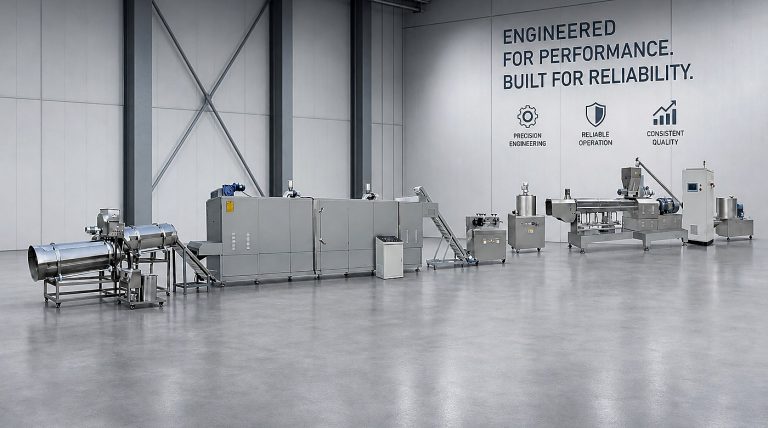
Recommended puffed grain process
- Mill or sieve the grain to the agreed particle-size specification.
- Batch and mix grain flour, starch and minor ingredients.
- Transfer the mixture with a controlled food screw conveyor.
- Cook, mix and shape the material in a twin-screw food extruder.
- Convey the cut pieces without damaging their structure.
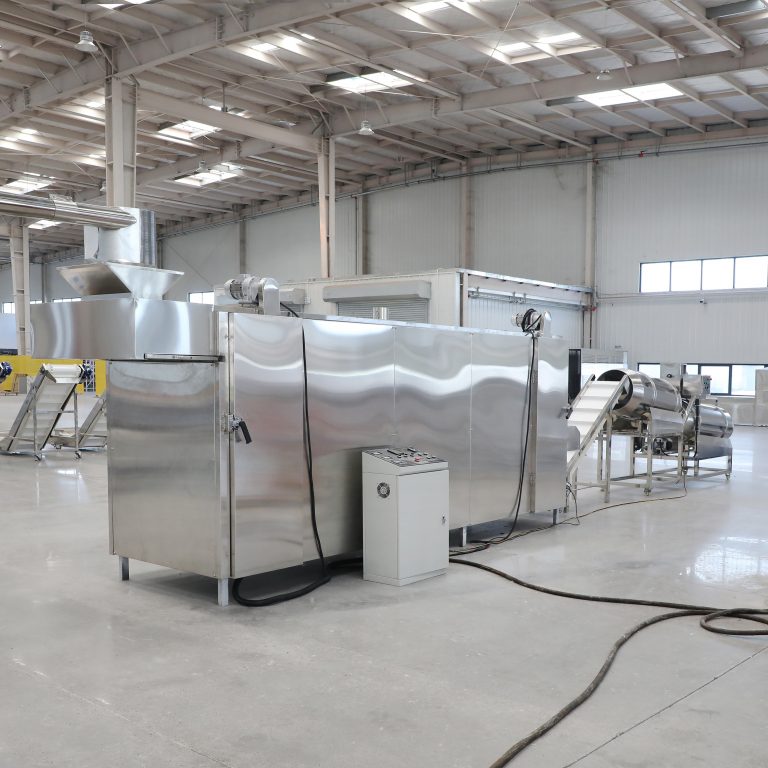
- Reduce moisture in a matched hot-air or steam dryer.
- Apply oil, liquid flavour or powder seasoning as required.
- Cool, inspect and transfer the product to packaging.
The detailed puffed snack process flow guide explains the purpose of each production stage and the consequences of an unstable feeder, undersized dryer or mismatched seasoning system.
Twin-screw or single-screw extruder?
A twin-screw extruder is normally the practical choice for directly expanded cereal and multigrain snacks because it offers stronger mixing and a wider operating window for changing formulas. A single-screw system is more commonly considered for certain simple formulas or pellet processes. The correct choice depends on the finished product, not only the purchase price of the extruder.
Reference ZEKO capacity options
| Extruder model | Reference output | Typical project use |
|---|---|---|
| ZK-65 | Approximately 100 kg/h | Small commercial line and product development |
| ZK-70 | Approximately 200–250 kg/h | Medium snack production project |
| ZK-85 | Approximately 300 kg/h | Continuous commercial production |
| ZK-95 | Approximately 500 kg/h | Larger continuous snack factory |
ZEKO can configure complete lines up to approximately 1,000 kg/h. These figures are references, not guarantees for every formula. Actual saleable output depends on grain composition, process moisture, die shape, required expansion, dryer loading, seasoning and packaging.
What affects puffed grain production line price?
- Stable finished-product output in kilograms per hour
- Direct expansion or pellet process
- Number of formulas, shapes and die sets
- Dryer heat source, zones and residence time
- Seasoning method and flavour-change requirements
- Automation, conveyors and packaging equipment
- Food-contact material specification
- Voltage, workshop layout and export configuration
A wheat puff line price, rye puff project or freekeh snack plant should therefore be calculated from the complete process. Comparing only extruder motor power can hide the real bottleneck in feeding, drying or packing.
What ZEKO needs for a useful quotation
Send the finished-product photo or market sample, ingredient list, estimated grain percentages, target shape, texture, bag size and required saleable output. Also confirm the factory voltage and frequency, workshop dimensions, ceiling height, available heat source and any limits on power or fuel.
For a new material, the most useful next step is a formula discussion followed by a trial plan. The trial should record flour specification, batch formulation, feed rate, moisture addition, operating stability, finished dimensions, bulk density, texture and dryer result. The agreed sample then becomes a clearer basis for equipment selection and the later factory acceptance test.
Factory acceptance and scale-up
A factory acceptance test should evaluate more than whether the machines switch on. For a grain puff project, the buyer and supplier should agree on the test formula, measuring method, stable running period, acceptable product appearance and how output will be calculated. Use the food production line FAT checklist to prepare the acceptance criteria before manufacturing is completed.
Frequently asked questions
Can one line produce wheat, rye, triticale and freekeh puffs?
One twin-screw line can support multiple products, but each formula may require different raw-material preparation, die tooling, moisture, screw speed, barrel settings, drying and seasoning. Changeover and cleaning time should be included in the production plan.
Can a specialty grain expand without corn or rice starch?
Sometimes, but the answer cannot be determined from the grain name alone. Flour properties, fibre, protein, fat, particle size and the target texture all matter. A product trial is the responsible way to confirm whether a supporting starch or cereal base is required.
How should dryer capacity be selected?
The dryer is selected after extruder output, piece size, incoming moisture, target final moisture and residence time are confirmed. An undersized dryer can limit the complete line even when the extruder itself has spare capacity.
How many operators are normally required?
A compact automated line may run with one or two operators around the extrusion and seasoning section, but total staffing also depends on raw-material batching, quality checks, flavour changes and packaging. The quotation should separate machine automation from total factory labour.
Related planning guides
For a quinoa-specific investment decision, use the quinoa puffs manufacturing plant cost guide to define the trial, equipment, utility and packaging scope before comparing quotations. For directly expanded non-fried products, see the hot-air expanded snack production line guide for the linked extrusion, drying, cooling and acceptance decisions.
Technical references
- NC State Extension: Extrusion Processing—A Versatile Technology for Producing Foods and Feeds
- Journal of Cereal Science: Triticale extrudates and the effects of process moisture and temperature
- Washington State University: Wheat-bran level and expanded snack properties
- Critical Reviews in Food Science and Nutrition: Green wheat freekeh processing review
Plan a grain puff line around your actual product
Do not begin with a generic equipment list. Begin with the grain specification, formula range, target sample, required saleable output and factory utilities. ZEKO can then compare the extrusion, drying, seasoning and packaging configuration as one connected process.
View the Puffed Snack Production Line Request a Production Line Proposal
Continue Reading