Technical Article
Quinoa Puffs Manufacturing Plant Cost: Equipment, Capacity and Utility Breakdown
A quinoa puff factory cannot be priced responsibly from one capacity number. Two projects both described as “150 kg/h” may require different extruders, drying areas, flavoring systems, packaging machines and utility loads. The difference begins with the product: a lightly expanded whole-grain snack, a directly expanded quinoa-flour puff, and a corn-based puff containing a small proportion of quinoa are not the same process.
For owners and project managers, the useful question is therefore not simply How much does a quinoa puffs manufacturing plant cost? It is: What equipment and factory scope are required to deliver the target product at a stable saleable output? This guide provides a practical framework for defining that scope before comparing quotations.
1. Define the quinoa product before selecting the line
“Quinoa puffs” can describe several products. Their equipment requirements and processing risk are different:
- Direct-expanded extruded puffs: quinoa flour or a quinoa-based blend is mixed, cooked and shaped in an extruder. This route is suitable for rings, balls, curls and other shaped snacks.
- Multigrain puffs with quinoa: quinoa is combined with corn, rice or another starch source. The blend may expand more easily and can give a different texture and ingredient cost.
- Whole-grain popped quinoa: the product relies on grain conditioning and puffing rather than the standard shaped-snack process.
- Pellet-based products: an intermediate pellet is produced or purchased, then expanded by frying or hot air in a separate step.
This distinction must appear in the request for quotation. A machine list prepared for a corn-rich direct-expanded curl should not be assumed to produce a high-quinoa formula with the same output, bulk density or texture.
2. Formula trials are part of the investment decision
Quinoa composition, variety, particle size and blend ratio influence expansion. Published extrusion work also shows that feed moisture, barrel conditions and screw speed affect the final extrudate. In one study of puffed quinoa, direct extrusion was tested across a range of feed-moisture levels, and the best expansion occurred within a narrower operating region rather than increasing continuously. Another extrusion study reported that quinoa expanded less readily than typical corn or wheat materials under the tested conditions.
For a commercial project, this means that the supplier should not select the line from a catalogue capacity alone. A trial should evaluate:
- the exact quinoa variety, flour specification and target inclusion rate;
- supporting starches, protein, fiber, oil, sugar and mineral additions;
- target shape, piece size, bulk density, hardness and expansion ratio;
- acceptable breakage, fines and color change;
- moisture entering the extruder and moisture after drying;
- seasoning pickup and finished-product shelf-life requirements.
A trial is not an optional demonstration. It is how the buyer confirms whether the proposed screw configuration, die, motor, dryer and seasoning system match the real product.
3. Base capacity on saleable finished product
Extruder throughput is not automatically finished-line capacity. The commercial output can be restricted by pre-mixing, feeding stability, drying time, flavor application, cooling or the number of packs the packaging section can complete per minute.
Use the following definition when sending an inquiry:
Saleable output (kg/h) = accepted packed product produced during stable operation ÷ actual operating hours
The calculation should exclude startup waste, off-spec texture, excessive fines, product waiting for the dryer and unpacked accumulation. Also state the product’s bulk density and pack size. A low-density puff in small retail bags creates a much higher bag-per-minute demand than the same mass of dense product in bulk packs.
4. What equipment belongs in the plant cost?
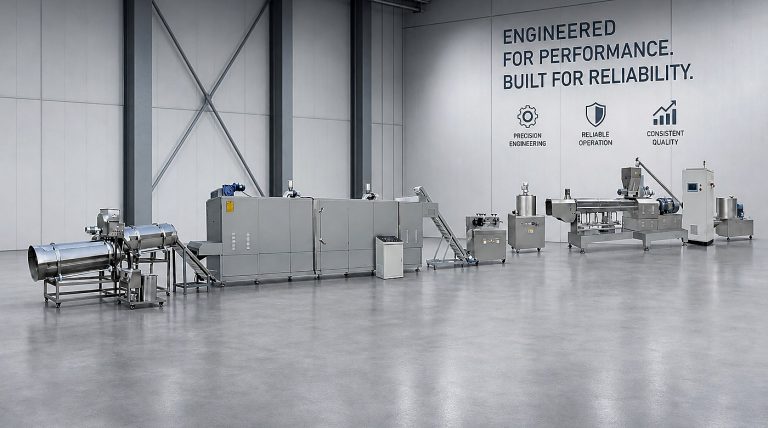
| Process section | Typical scope | Cost and performance question |
|---|---|---|
| Raw-material preparation | Cleaning, milling or flour receiving, weighing and storage | Will the factory buy ready-milled quinoa flour or process grain onsite? |
| Mixing and feeding | Powder mixer, liquid dosing and controlled feeder | Can the system hold the recipe and feed rate consistently? |
| Extrusion | Preconditioner if required, twin-screw extruder, cutter and dies | Is motor, screw design and barrel L/D selected from trials? |
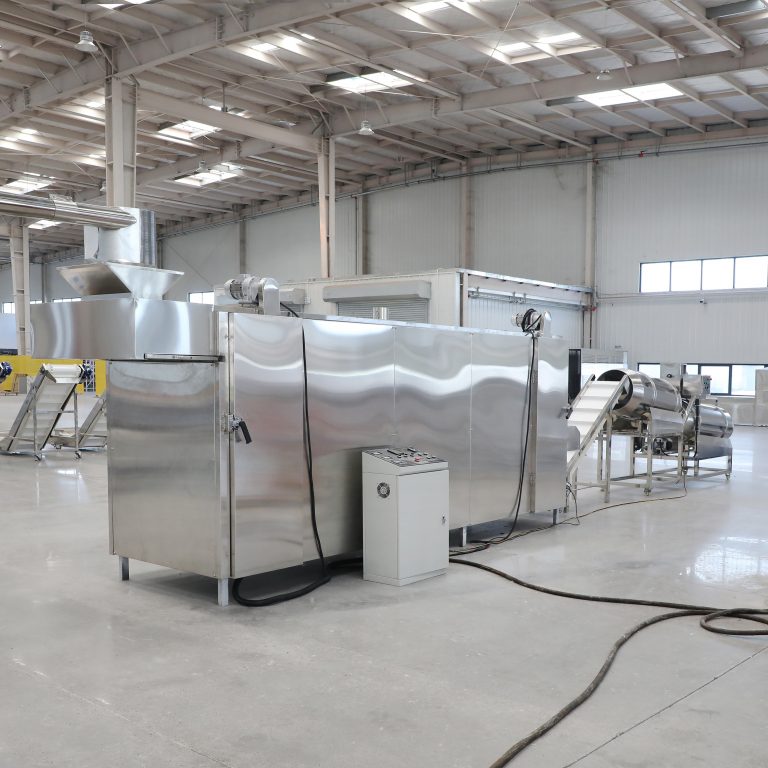
| Conveying and drying | Air conveyor, elevator and multi-pass hot-air dryer | What inlet moisture, final moisture and residence time define the dryer load? |
| Flavoring | Oil spray, powder dosing and coating drum | Is the recipe oil-free, lightly sprayed or fully seasoned? |
| Cooling and inspection | Cooling conveyor, screening, metal detection and checkweighing | Which food-safety controls are required by the target market? |
| Packaging | Weigher, vertical bagger, gas flushing, conveyors and case packing | What bag sizes, film, packs/minute and residual-oxygen target apply? |
| Utilities and support | Electrical distribution, gas or steam, compressed air, spares, laboratory tools and installation | Which items are included by the machinery supplier and which belong to the buyer? |
Buyers can review the main process equipment on ZEKO’s puffed snack production line, twin-screw extruder, hot-air and steam dryer and automatic food packaging machine pages.
5. The dryer should be sized from water removal, not only kilograms per hour
Extruded pieces leave the die hot and moist. The dryer must remove enough water to achieve the required texture and storage stability without scorching the surface or leaving an uneven core. The required duty depends on incoming moisture, final moisture, product geometry, bed depth, air temperature, airflow and residence time.
Two products at the same mass throughput can impose different dryer loads. A dense pillow, a thin ring and a small ball do not expose the same surface area or move through a belt dryer in the same way. The quotation should therefore state the test product, moisture basis, residence time and heat source. It should also identify whether quoted energy consumption covers only the extruder or the entire line.
6. Packaging is a production constraint, not an afterthought
Puffed products lose crispness when they absorb moisture. FAO processing guidance notes the importance of moisture-proof packaging for crisp puffed and flaked products. For a quinoa snack, the packaging decision should cover barrier performance, seal integrity, pack volume, nitrogen flushing if required, and the expected distribution environment.
The packing section must be matched in bags per minute, not just kilograms per hour. Before equipment selection, provide:
- the smallest, most common and largest pack weights;
- expected product bulk density and piece dimensions;
- pillow bag, gusset bag or other pack style;
- film structure and maximum reel dimensions;
- date coding, metal detection and checkweighing requirements;
- target residual oxygen and shelf life, if gas flushing is used;
- manual or automatic case-packing scope.
A line that produces enough kilograms but cannot package the planned retail formats is not a complete plant.
7. Factory and installation costs outside the machine quotation
Machine price is only one part of project investment. The buyer should create a separate factory-scope budget for items such as:
- building, food-grade floor, drainage, ventilation and access platforms;
- transformer capacity, cables, distribution panels and local electrical compliance;
- gas train, steam generation or electric-heating infrastructure;
- compressed air, water treatment and process-water distribution;
- raw-material and finished-goods storage;
- quality laboratory, sanitation equipment and pest control;
- freight, insurance, customs, inland transport and lifting;
- installation supervision, commissioning ingredients and trial packaging film;
- operator training, startup waste and initial spare parts.
Ask every supplier to provide a written battery-limit or scope-boundary document. It should state exactly where the supplier’s responsibility starts and ends for power, fuel, air, water, exhaust, product conveyors and packaging integration.
8. Compare quotations on one technical basis
A useful quotation should answer the same questions for every candidate supplier. At minimum, request:
- tested recipe or an agreed reference formula;
- guaranteed saleable output range and the conditions behind it;
- complete equipment list with model, motor and contact-material specification;
- dryer heat source, installed power and estimated operating consumption;
- expected finished moisture, bulk density and product-loss assumptions;
- packing formats and bags-per-minute range;
- layout, ceiling-height requirement and maintenance clearances;
- utility schedule and connection points;
- installation, commissioning, training, warranty and spare-parts scope;
- factory acceptance test criteria and unresolved-item procedure.
Use our food machinery quotation checklist to prepare these inputs before requesting a commercial proposal.
9. Build the business case from contribution per saleable kilogram
A basic investment model should separate fixed investment from production economics. Calculate expected annual saleable volume from scheduled hours, realistic utilization, yield and accepted product—not from 24-hour theoretical operation.
Annual saleable volume = saleable kg/h × scheduled hours × utilization × first-pass yield
Then estimate contribution per kilogram after quinoa and other ingredients, flavoring, packaging film, energy, direct labor, quality loss and distribution-related costs. Test several scenarios for product price, quinoa cost, utilization and packaging speed. This makes it possible to see whether the project is mainly sensitive to equipment price, ingredient cost, market demand or operating efficiency.
The strongest project sequence is usually: confirm market and product specification, run a representative trial, freeze the process and packaging scope, compare technically aligned quotations, then complete the financial model.
Related planning guides
For wheat, rye, triticale and freekeh formats, compare formula and processing factors in our puffed grain production line guide. If your target is a directly expanded non-fried snack, review the hot-air expanded snack production line guide to plan extrusion, drying and seasoning as one route.
Technical references
- International Journal of Food Science & Technology: Physical, chemical and nutritional characteristics of puffed quinoa
- Washington State University Research Exchange: Extrusion processing characteristics of quinoa
- FAO: Cereal and pulse-based products
Planning a quinoa puff production project?
Send ZEKO your target product, quinoa percentage, finished output, pack sizes, heat source and destination country. We can review the process scope and identify the information still needed before preparing a practical line proposal.
Continue Reading