Technical Article
Puffed Snack Market Entry: A Factory Owner’s Pre-Purchase Decision Framework
Buying an extruder is not the first decision in a puffed snack project. The first decision is whether the proposed product, production route, capacity and factory conditions form one workable system. A line can run and still be the wrong investment if the product range is too broad, the utility plan is incomplete, or the output cannot be packed and sold consistently.
This guide is for owners and project managers who are defining a direct-expanded snack project before sending machinery inquiries. It does not replace product trials, local engineering or food-safety advice. Its purpose is to make the first equipment discussion more specific: what product are we making, how will it be produced, what has to be true for the factory to run, and what evidence should the supplier provide?
Start with a product decision, not a machine list
“Puffed snack” is a market category, not a single process. Corn curls, rings, balls, cereal snacks, coated snacks and filled sticks can share part of a line while placing very different demands on forming, drying, coating, seasoning and packaging. Define the commercial product before comparing extruder sizes.
- Product form: direct-expanded corn snack, cereal snack, pellet-based snack, filled snack or a mixed portfolio.
- Eating target: light and crisp, dense and crunchy, coated, sweet, savoury or filled.
- Formula boundary: principal starches, inclusions, allergens, sugar/fat level and any nutrition claim.
- Pack format: pillow bag, cup, sachet, multipack or another route that sets the packaging requirement.
- Commercial range: launch with a small, repeatable group of SKUs; do not make every possible shape and flavour a day-one promise.
The objective is not to make the brief restrictive. It is to identify what must be stable at launch and what can wait until the operating team has data. A good supplier can then size equipment around a defined route rather than quote a generic line.
Choose the production route before specifying capacity
Direct-expanded snacks
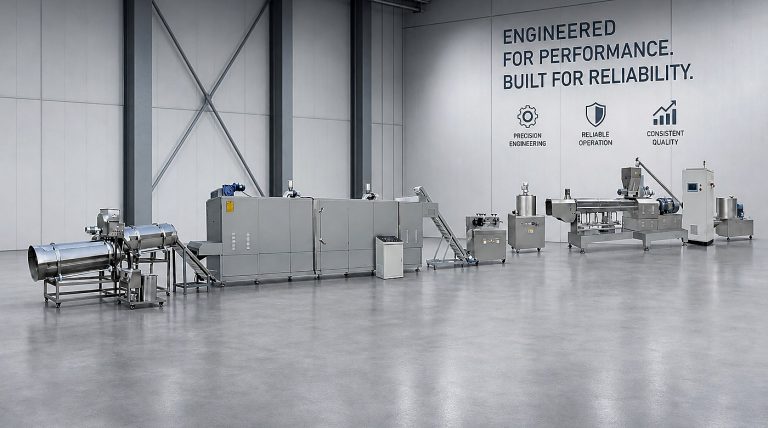
For many corn- and cereal-based snacks, the route is dry ingredient handling, dosing and mixing, extrusion cooking and forming, then drying or cooling as needed, oil/coating, seasoning, inspection and packaging. The extruder creates the expanded structure, but it is not the entire production system. Moisture control, product transfer and downstream residence time determine whether the product remains consistent after it leaves the die.
ENERGY STAR’s cereal-production guide describes extrusion cooking as one of the precooking routes used for cereal products, while other cereal formats follow different forming, baking, drying and packaging paths. That is a useful reminder: nameplate machinery is not a substitute for matching the process to the finished product.
Pellet, fried or baked routes
Pellet products, fried snacks and baked products should not be treated as a small variation of direct expansion. They can require different forming, moisture management, frying or baking, oil control, cooling and cleaning provisions. If the business plan includes more than one route, decide whether the first phase needs a common upstream system with dedicated downstream modules, or whether separate production routes are the safer choice.
Translate a sales plan into an operating capacity
A supplier’s stated kg/h is a reference point, not the production plan. The useful question is: how many saleable packs can the plant produce during a realistic shift after start-up, planned cleaning, changeover, quality holds and packaging stops?
Build the capacity discussion in this order:
- Expected monthly demand by the few products that will actually launch.
- Target operating days and shifts, including realistic maintenance time.
- Expected yield and reject allowance by product, not just raw-material input.
- Run duration between flavour, die or pack changes.
- Packaging-machine rate and number of pack formats.
- Finished-goods cooling, storage and dispatch constraints.
Use the result to request a capacity range for each launch product. If one product is the benchmark, state it. A line that produces one shape efficiently may need different settings, tooling or downstream time for another.
For a separate planning method, see our guide to food extrusion line capacity planning. Before placing an order, ask the supplier to show the assumed product, moisture range, line configuration and packing condition behind every capacity statement.
Map the whole line: the bottleneck is often downstream
In a quotation, the extruder may be the most visible machine. In operation, however, lost time often comes from the interfaces: unstable feeding, product buildup in transfer points, a dryer that cannot keep pace, seasoning variation, insufficient cooling before packing, or a packaging machine waiting for product.
Review the project as connected zones:
- Raw-material receiving and storage: ingredient condition, dust control, access and traceability.
- Dosing and mixing: recipe accuracy, batch consistency and cleaning access.
- Extrusion and forming: product trial evidence, die changes and operator controls.
- Drying/cooling: residence time, moisture target and a clear interface to coating.
- Oil, coating and seasoning: application uniformity, recovery, cleaning and allergen management.
- Packaging: product protection, checkweighing/metal detection as applicable, date coding and pack-change time.
Ask the supplier for a process-flow drawing that names every handoff. This makes it easier to locate utility points, floor drainage, walkways, guarding and future expansion space before equipment arrives. Our puffed snack process-flow guide can help structure that conversation.
Define the factory constraints early
Equipment selection cannot be separated from the building. Confirm the available electrical supply, compressed air, water and drainage, ventilation/exhaust, ceiling height, floor loading, access doors and material flow. Also define where operators will load ingredients, where product will cool, where packaging film will be stored and how cleaning will be carried out.
Food safety must be designed into the operating plan, not appended after installation. FDA guidance for covered human-food facilities describes a written food-safety plan built on hazard analysis and preventive controls; the exact regulatory requirements depend on market and facility, but the management principle is broadly useful. Layout, equipment cleanability, allergen separation, trained operators and documented controls deserve review during the project phase.
For a detailed physical checklist, read factory requirements for a food extrusion production line. Have a local qualified engineer and food-safety adviser validate site-specific requirements.
Build a first-pass economics model before negotiating equipment price
Do not decide on a line only from the equipment price. The management case should include all recurring drivers that move the cost of a saleable bag:
- Raw materials, recipe loss and yield.
- Energy, including heating, drying, air and cooling demand.
- Packaging material and packaging speed.
- Direct labour, supervision, cleaning and planned maintenance.
- Quality checks, rework rules and scrap disposal.
- Spare parts, dies and planned change parts.
- Freight, installation, local construction and commissioning support.
Use ranges and assumptions rather than pretending the result is exact. The point is to test sensitivity: if yield is lower, packaging is slower or changeovers are more frequent than planned, does the project still work? Our puffed snack line cost-factors guide identifies the project inputs worth collecting before a quotation comparison.
Use a stage-gate before placing an order
A practical project should pass four gates:
- Concept gate: launch products, customer proposition, intended pack formats and initial volume are defined.
- Process gate: the product route, trial requirements, utilities, food-safety constraints and line scope are confirmed.
- Investment gate: the commercial model includes installation, building work, operating inputs, ramp-up and working capital, not only the machine price.
- Acceptance gate: the supplier and buyer agree in writing on capacity basis, product-quality criteria, documentation, safety checks, open items and site-acceptance plan.
That last gate matters. A factory acceptance test should verify more than a brief machine run. Use our practical FAT checklist for food production lines to make the evidence, run conditions and punch-list expectations clear before shipment.
What to send in your first project brief
A concise, complete brief produces a better technical reply than a one-line request for price. Include:
- Launch product photos or samples, target shape and expected recipe direction.
- Target capacity by product, operating hours and target market.
- Available utilities, building dimensions and layout constraints.
- Required modules: mixing, extrusion, drying, coating, seasoning, cooling, packaging and inspection.
- Desired supplier scope: equipment only, layout support, commissioning, training, spare parts and FAT documentation.
- Any compliance, sanitation, allergen or traceability requirements relevant to your market.
We can use that information to discuss a line scope and a configuration suitable for the project rather than proposing an oversized or incomplete package. Send a production-line project brief when you are ready to compare options.
References
Continue Reading