Technical Article
Dry Pet Food Production Line Cost: 8 Factors That Change a Quotation
The cost of a dry pet food production line cannot be defined responsibly from one machine model or one headline capacity. A complete kibble project may include grinding, batching, mixing, conditioning, extrusion, drying, oil and palatant coating, cooling, screening, conveying and packing. The quotation changes when the product, equipment boundary, automation level, utilities or acceptance requirements change.
This guide explains the eight factors that have the greatest effect on a commercial dry dog food or cat food line quotation. It does not publish a universal price range because two projects with the same nominal kilograms per hour can require very different equipment.
1. Define the finished kibble before comparing cost
The first cost driver is the product itself. Dog food and cat food may use different ingredient profiles, kibble sizes, densities, shapes and coating requirements. Higher protein, fibre or fat content can change feeding, extrusion behavior, drying load and product handling.
Provide the supplier with the main ingredient categories, representative formula information, desired kibble diameter, shape, density, final moisture and reference product. A common commercial size range may be approximately 3-20 mm, but the die, cutter, formula and target animal determine the final configuration.
If the project includes several recipes or frequent shape changes, state that at the quotation stage. Additional dies, recipe control, cleaning access and changeover requirements may affect the proposed scope.
2. Compare saleable output, not only extruder discharge
Capacity has a direct effect on equipment size, but the measurement point matters. Dry ingredient feed rate, wet product leaving the extruder, dried kibble and packed saleable output are not the same number.
ZEKO reference platforms for dry pet food include approximately 100 kg/h for ZK-65, 260-300 kg/h for ZK-70 and 400-500 kg/h for ZK-85. These are selection references, not universal guarantees. Formula, kibble density, diameter, moisture, coating and dryer load can change the practical finished output.
| Capacity question | Why it affects the quotation |
|---|---|
| Where is output measured? | The dryer, cooler and packing section must be sized for the same agreed product basis. |
| How many hours per shift? | Continuous production, cleaning and changeover expectations influence equipment and operating design. |
| How many recipes and sizes? | Product changes may require tooling, control and cleaning provisions. |
| What final moisture is required? | The water-removal duty determines dryer size and residence time. |
Use the food extrusion line capacity-planning guide to put different supplier proposals on the same saleable-output basis.
3. Confirm the raw-material preparation and extrusion scope
A quotation for an extruder alone is different from a quotation that begins with ingredient grinding and batching. The required preparation section may include crushing or milling, sieving, weighing, batch mixing, liquid addition, conveying and preconditioning.
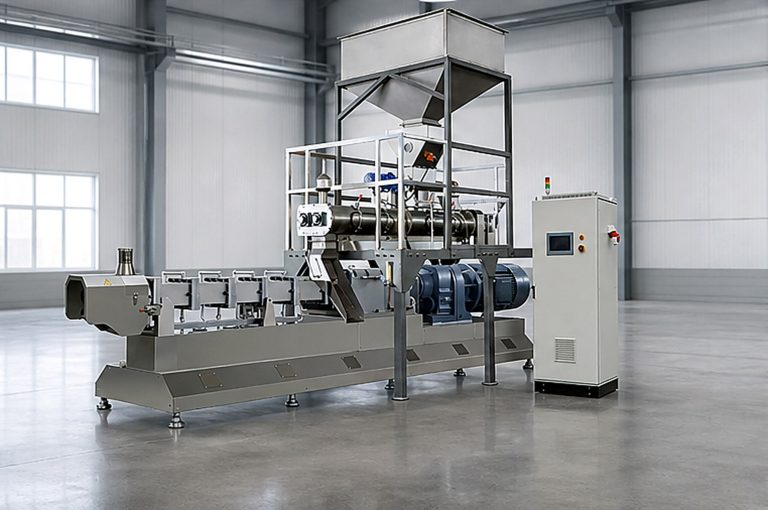
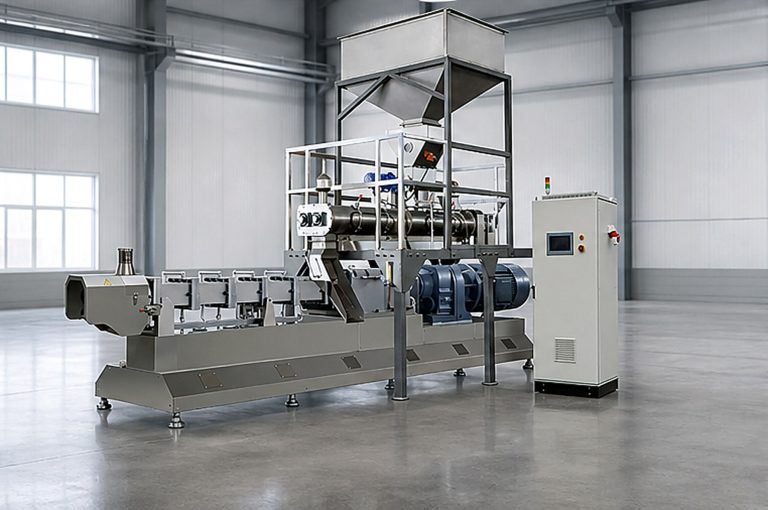
The twin-screw food extruder is the core cooking and shaping machine, but screw configuration, feeder, conditioner, die, cutter and control system are selected around the formula and finished kibble. A stand-alone extruder may be suitable for an existing factory with compatible upstream and downstream equipment. A new factory usually needs the interfaces defined as one connected process.
4. Size the dryer from moisture removal
The dryer is often one of the largest differences between quotations. It must remove the required water while maintaining product temperature, residence time, airflow and a stable final moisture. A large extruder paired with an undersized dryer cannot deliver the same finished output continuously.
Dryer cost changes with belt width, number of layers or zones, residence time, insulation, airflow design, controls and heat source. Electricity, natural gas or steam may be considered according to local utilities and project configuration. The supplier needs the moisture entering the dryer, target final moisture, kibble size, bed depth and hourly load.
Review the available industrial food dryer and hot-air or steam oven options as part of the complete line, rather than treating drying as an accessory added after extruder selection.
5. Define oil spraying, palatant coating and cooling
Dry pet food commonly requires external oil and palatant application after drying. The coating target affects tanks, pumps, spraying or coating equipment, controls and cleaning. The quotation should state whether liquid oil, liquid palatant, powder palatant or a combination is expected.
Cooling must then bring the product to a condition suitable for screening, storage and packing. If the kibble is packed too warm, condensation and storage problems can follow. Coating and cooling capacity must therefore match the stable dryer discharge.
6. Specify automation, materials and electrical requirements
A manually operated starter line and a more integrated line with PLC controls, recipe settings, interlocks and recorded process values do not have the same scope. Define which operators will control feeding, extrusion, drying, coating and packing, and which sections must communicate automatically.
Also confirm the required stainless-steel grade and food-contact boundary. A statement such as “stainless steel machine” is incomplete unless the quotation identifies which contact surfaces, frames, covers, tanks and conveyors use the specified material.
Destination voltage, frequency, phases and preferred electrical components must be confirmed before manufacturing. Control cabinets and motors selected for one country may not be suitable for another without modification.
7. Include utilities, packing and factory interfaces
The machinery price does not automatically include every factory connection. A useful quotation identifies the buyer and supplier boundary for electrical cables, gas or steam piping, compressed air, water, exhaust, drainage, platforms, foundations and lifting.
Packaging should be defined early even if it is purchased separately. Provide the bag type, net weight, product bulk density, required bags per minute, film specification and coding requirement. Small retail bags and larger sacks can require different weighing and handling arrangements.
Factory layout also affects the proposal. Share the workshop length, width, clear height, columns, door sizes and existing machines. A preliminary layout helps expose missing conveyors, service clearance or height restrictions before the equipment is built.
8. Compare service, testing and commercial scope
Two equipment quotations can differ because they include different services rather than different machinery. Ask suppliers to separate equipment, tooling, spare parts, freight, installation supervision, commissioning, training and travel costs.
A factory acceptance test should define the representative formula or material, stable running time, capacity measurement point, kibble size and appearance, moisture target, coating condition, safety checks and outstanding-action process. Use the food production line FAT checklist before the final equipment scope is approved.
Dry pet food line quotation comparison table
| Quotation item | Information the buyer should provide | What the supplier should state |
|---|---|---|
| Product | Dog or cat food, formula category, kibble size, shape and sample | Process suitability, tooling and assumptions |
| Capacity | Required saleable kg/h and working schedule | Measurement point and reference product |
| Drying | Incoming and final moisture, heat source and product load | Zones, residence time basis and matched capacity |
| Coating | Oil and palatant type and application ratio | Equipment, controls and cleaning scope |
| Automation | Operator plan, recipe changes and required records | Control boundary, interlocks and included instruments |
| Factory | Layout, voltage, utilities and access | Utility list and buyer-supplied interfaces |
| Packing | Bag style, weight, film and speed | Included machine or defined handover point |
| Service | Destination, schedule and support expectation | Installation, training, FAT, warranty and exclusions |
Information ZEKO needs before preparing a quotation
- Finished dry dog food or cat food product and reference photos
- Main raw materials or formula category
- Kibble diameter, shape, density and final-moisture target
- Required saleable output per hour
- Oil and palatant coating requirement
- Bag style, net weight and packing speed
- Factory voltage, heat source and workshop dimensions
- Required equipment boundary from preparation through packing
- Destination country and expected project schedule
For the complete processing route, review the ZEKO dry pet food extrusion line and the detailed pet food extruder and kibble line guide. A project-specific quotation can then define the exact equipment, assumptions and exclusions.
Frequently asked questions
Why does ZEKO not publish one fixed pet food production line price?
The equipment boundary, formula, capacity, dryer, coating, automation, materials, utilities, packing and service scope vary by project. Publishing one number without these inputs would not describe a comparable line.
Can I purchase only the pet food extruder?
Yes. A stand-alone extruder can be evaluated for an existing factory, but the feeder, dryer, coating and other interfaces must be compatible with the required formula and output.
Can one line make both dog food and cat food?
A dry-kibble line can be evaluated for several products, but each formula, kibble size, die, cutter setting, drying condition, coating requirement and cleaning plan must be confirmed.
What information is most important for a first quotation?
Send the final product, raw materials, kibble size, target saleable output, coating requirement, factory voltage, heat source, workshop dimensions, packaging plan and destination.
Prepare a project-specific equipment scope
A useful cost discussion begins with a common technical basis. Send ZEKO the product target, formula category, output, factory conditions and required line boundary. We can identify which sections belong in the proposal and which assumptions still need confirmation.
Continue Reading