Technical Article
How to Choose a Food Extruder Machine Before Comparing Quotes
Two food extruder machine quotations can look similar at first glance: the same product name, a similar model family, and a stated hourly capacity. Yet they may cover very different equipment, operating conditions and finished-product results. That is why an enquiry that only says “we need a 300 kg/h extruder” is usually not enough to compare proposals fairly.
A useful comparison starts with the finished product and works backward through extrusion, drying, cooling and any packing connection. This guide sets out the questions worth answering before you ask suppliers to quote a food extruder machine.
If your next step is budget comparison, review the food extruder machine price factors that change quotation scope before comparing headline prices.
1. Define the product route before choosing the machine
“Food extrusion” covers several different routes. Directly expanded snacks, breakfast cereal, dry pet food and aquatic feed can all use twin-screw processing, but they do not use the same formula, die, cutter, moisture target or downstream equipment.
- For puffed snacks, the buyer normally needs to define the desired expansion, shape, texture, seasoning route and drying method.
- For dry pet food, kibble size, density, drying, cooling and post-drying coating need to be part of the discussion.
- For fish feed, pellet diameter and the required floating, slow-sinking or sinking behaviour change the selection basis.
Start with a product photo or sample, the main raw-material categories, the desired shape and size, and the intended market. This gives the supplier a real basis for discussing screw configuration, die tooling and the processing route.
2. Ask what the stated capacity actually means
Capacity is the first place where quotations become difficult to compare. One supplier may state wet feed into the extruder, another may state extruder discharge, and a third may mean saleable finished product after drying and cooling. Those numbers are not interchangeable.
For a complete line, define the same basis for every proposal:
- Is the target expressed as wet material, extruder discharge or finished saleable product?
- What product moisture and product condition are assumed at the end of the line?
- Does the dryer, cooler and optional packing section handle the same practical load?
- What operating hours, yield and normal handling loss are included?
The food extrusion line capacity checklist explains the five numbers to confirm before using capacity as a comparison point. It is better to get these numbers clear before discussing model names.
3. Separate a stand-alone extruder from a complete line
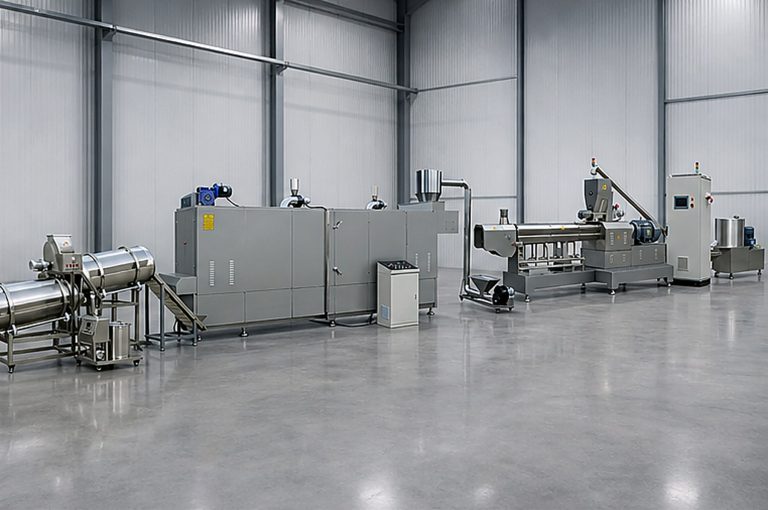
A food extruder machine can be supplied as a core unit for an existing factory, or as part of a wider line. Neither scope is automatically better. The right choice depends on what is already installed and whether the existing feeding, drying, conveying and finishing equipment can support the new product.
When comparing a stand-alone machine, confirm the interfaces: material feeding method, transfer height, control connection, available utilities, discharge arrangement and the downstream dryer or conveyor. When comparing a complete line, make sure the scope clearly says which sections are included and which are optional.
Our machine-versus-complete-line guide is useful when an equipment list looks comprehensive but the boundary between supplied equipment and buyer-supplied equipment is not clear.
4. Select the twin-screw platform around the approved product
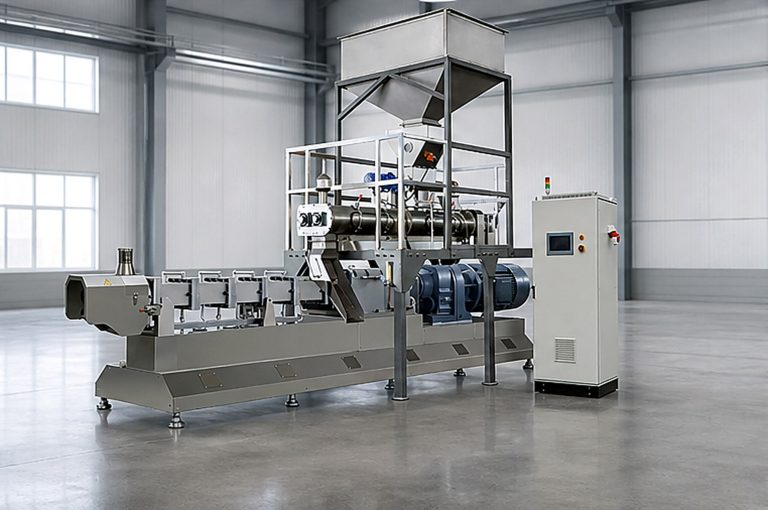
ZEKO currently evaluates laboratory platforms and ZK-65, ZK-70, ZK-75, ZK-85 and ZK-95 industrial platforms. A model number alone does not guarantee a particular output or result. Formula, moisture, density, die design, expansion ratio, cutter arrangement and downstream drying load all affect the practical output.
Instead of asking only for the largest available machine, ask which platform fits the product, why it has been selected, and what conditions the supplier used to assess capacity. A clear answer should link the model to the product target, not just list motor power or a headline throughput.
5. Check the equipment that comes after extrusion
The extruder creates the structure, but it does not complete the process. Expanded snacks, kibble and aquatic feed normally need the next stages to be considered at the same time: conveying, drying, cooling, seasoning or coating, and sometimes packing.
A dryer that is too small can become the line constraint even when extrusion is stable. A cooling or packing arrangement that is not matched to the practical output can create handling problems at the end of the line. For this reason, the supplier should describe how the extruder, dryer and finishing sections are balanced around the same finished-product target.
6. Put configuration details into the quotation request
A serious comparison is easier when every supplier receives the same project brief. The following details reduce assumptions and make the resulting proposals more useful:
- Finished product type, clear photos and target shape or diameter
- Main ingredients or formula category
- Required output and the exact capacity basis
- Initial and target moisture where relevant
- Existing equipment that must connect to the new machine
- Factory voltage, frequency, available heat source and workshop dimensions
- Whether the requirement is a single machine, a complete line, or an upgrade
- Preferred testing and acceptance conditions before shipment
These are not administrative details. They are the inputs that determine the screw, die, cutter, dryer duty, layout and final equipment scope.
7. Agree how the proposal will be tested
Before placing an order, agree what representative material and product target will be used for discussion or factory testing. Define the capacity basis, product shape, relevant quality checks and the open items that still require confirmation. This protects both the buyer and the supplier from comparing a machine against an undefined product condition.
Use the food production line factory acceptance checklist to prepare this discussion before a final configuration is confirmed.
A practical way to compare food extruder machine proposals
Put every proposal next to the same product brief. Check the product route, capacity basis, included scope, dryer and finishing capacity, utilities, test conditions and excluded items. The strongest proposal is not necessarily the one with the largest headline number. It is the one that explains how the equipment will make the required product at a defined, stable finished-product output.
If you are planning a snack, cereal, pet food, fish feed or nutrition-powder project, send the product information, capacity target and factory conditions to ZEKO. We can discuss whether you need a stand-alone twin-screw food extruder or a complete processing route.
Questions buyers often ask
Is a twin-screw food extruder suitable for every food product?
No. Twin-screw extrusion is commonly evaluated for directly expanded snacks, breakfast cereals, dry pet food, aquatic feed and suitable cereal or nutrition products. The formula and intended finished product determine whether it is the appropriate route.
Why do suppliers give different outputs for a similar machine?
Output changes with formula, moisture, product density, die shape, expansion, cutter settings and the capacity of downstream drying and cooling. Compare the capacity basis and assumed product conditions before comparing model numbers.
Can ZEKO supply only the food extruder machine?
Yes. A twin-screw unit can be supplied for an existing line, or it can be specified with feeding, conveying, drying, seasoning, cooling and packing sections for a complete project.
What should I send before requesting a quote?
Send the product photo or sample, raw-material categories, target shape, required capacity, factory voltage, available utilities, workshop size and whether you need a single machine or a complete line.
Download the Food Extruder Buyer Guide
Use this printable technical checklist to compare product route, complete-line scope, capacity basis, utilities and factory acceptance conditions before requesting a food extruder quotation.
Continue Reading