Technical Article
Industrial Microwave Dryer Price: 8 Factors That Change a Food Processing Quote
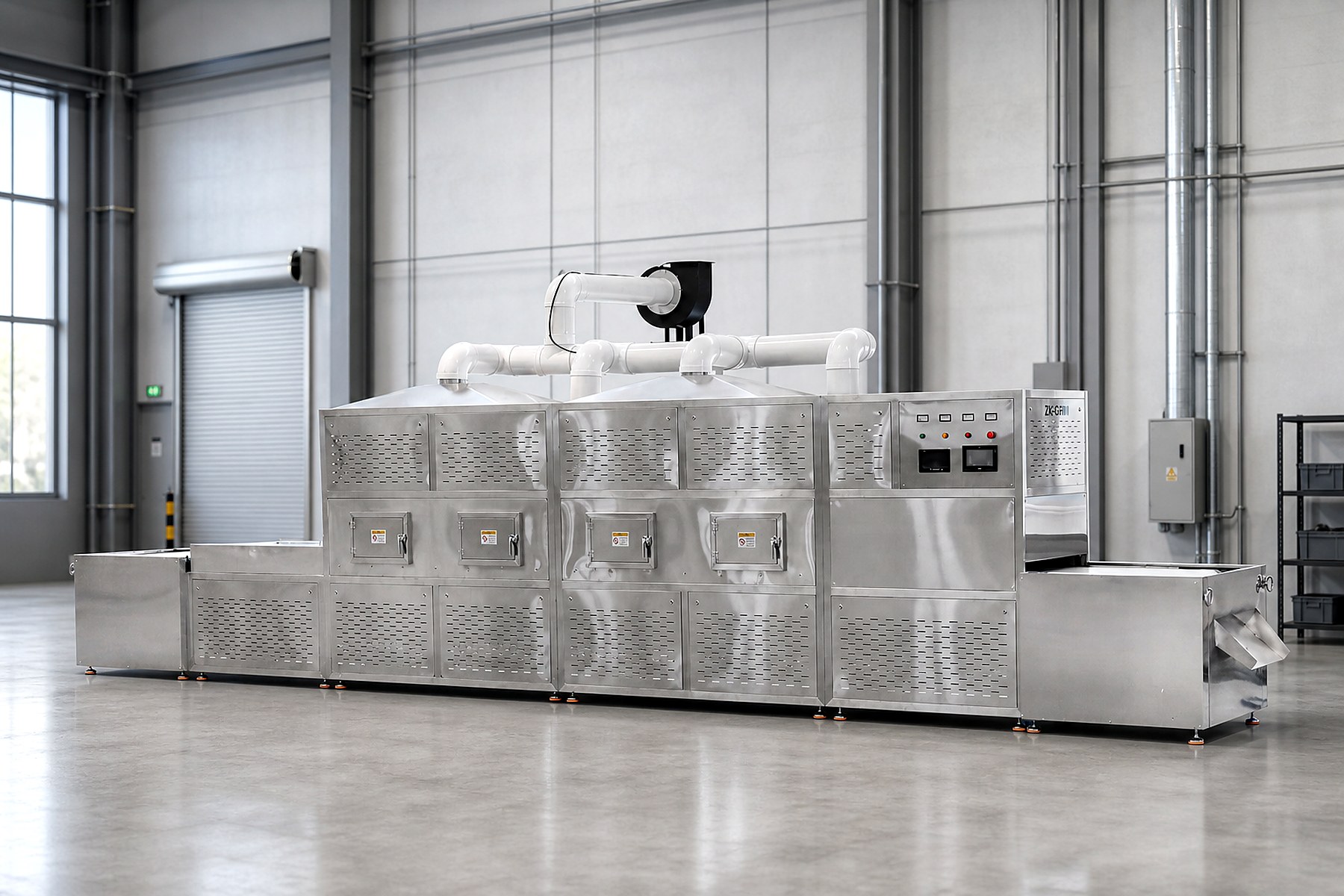
An industrial microwave dryer price cannot be defined by microwave power alone. Two systems with a similar kW rating can have very different chamber lengths, belt widths, loading methods, cooling requirements and control scope because the material, moisture removal and production target are different.
This guide explains the main quotation factors buyers should confirm before comparing industrial microwave dryer offers. For the core equipment route, see ZEKO’s industrial microwave drying and sterilization equipment page.
1. Material type and required process result
Microwave equipment may be evaluated for drying, heating, sterilization, enzyme inactivation or another defined thermal process. Herbs, spices, powders, seafood, fruit, pet treats and other materials do not absorb energy or release moisture in the same way. A useful quotation begins with the material, its product form and the required outcome.
2. Initial and final moisture
The water to be removed is one of the main inputs for industrial microwave dryer sizing. State the initial moisture, final target, feed condition, layer thickness and allowable product temperature. A request that only says “dry the product” does not provide enough information to select practical power or residence time.
3. Required throughput and loading depth
Hourly capacity should be defined with the actual material condition and moisture target. Belt width, chamber length, conveyor speed and product loading depth are matched together. A high stated hourly rate is not useful unless the loading pattern and final product quality can be maintained.
| Quotation input | Why it changes system scope |
|---|---|
| Material and product form | Affects microwave response, feeding and chamber design |
| Initial and final moisture | Defines the moisture-removal duty |
| Target kg/h and loading depth | Guides belt width, chamber length and residence time |
| Temperature limit and quality target | Affects process control, cooling and validation needs |
| Required function | Separates drying, heating, sterilization or combined process scope |
4. Microwave power and chamber configuration
Power is selected around the actual moisture-removal or heating duty, not as a standalone price comparison. The chamber design, applicator arrangement, belt width, length, shielding, exhaust and control system must work together with the material. A system should be compared on the accepted process result rather than only on the number of kW listed in a proposal.
5. Feeding, conveying and product handling
Powders, leaves, pieces, strips and wet materials may need different feeding and distribution arrangements. The product has to enter the chamber at a controlled, repeatable loading depth. Upstream dewatering, spreading, conveying and discharge handling can be as important as the microwave section itself.
6. Cooling, exhaust and downstream connection
Some projects need cooling, moisture exhaust, air handling, screening, packing or a hot-air finishing stage after microwave treatment. Define what is included in the supplier scope and what is already available in the factory. For a process comparison, see ZEKO’s industrial microwave dryer versus hot-air dryer guide.
7. Controls, safety and destination-factory utilities
Voltage, electrical capacity, water cooling where applicable, ventilation, workshop space, material handling and destination requirements all affect the final configuration. The quotation should identify the supplied control system, safety interlocks, shielding, conveyor interfaces and installation responsibilities.
8. Material testing and acceptance evidence
For a new material or a strict quality target, a trial is often more valuable than comparing generic machine prices. Agree the representative material, loading depth, initial and final moisture, temperature limit, expected throughput and the evidence to be recorded. Use the industrial microwave dryer testing checklist before requesting a final configuration.
What to send for an industrial microwave dryer quote
- Material description, product photos and particle or product dimensions
- Required process: drying, heating, sterilization or another defined result
- Initial and final moisture, temperature limit and quality target
- Target hourly throughput and practical loading depth
- Available voltage, water, ventilation and workshop layout
- Existing upstream and downstream equipment, including cooling or packing
ZEKO can evaluate the microwave chamber, conveyor, cooling, exhaust and control scope around the real material requirement. Send a microwave project brief for a quotation discussion.
Continue Reading