Technical Article
Food Extrusion Line Capacity Planning: How to Calculate Saleable Output Before You Buy
“How many kilograms per hour can this line make?” is the right opening question, but it is not enough to compare food extrusion proposals. A supplier may quote the maximum output of an extruder, while the buyer needs the stable amount of finished, packed product that can actually be sold.
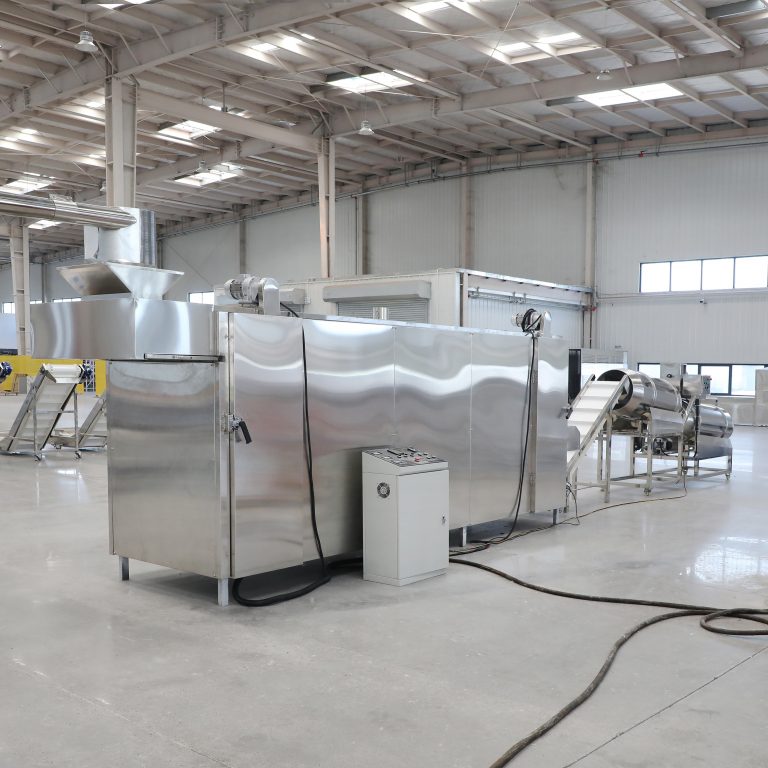
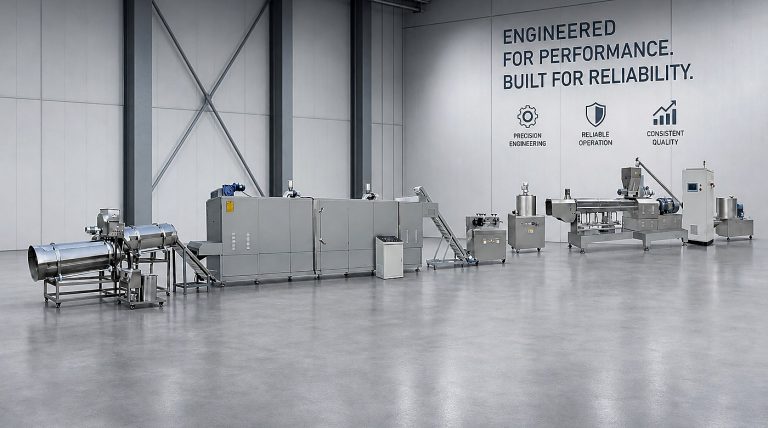
Those figures can be very different. A line can have an extruder capable of a high short-run throughput while its dryer, seasoning system, cooler, packing machine, raw-material feeding or changeover procedure limits the real operating rate. The most useful capacity plan therefore treats an extrusion line as one connected production system rather than a collection of individual machines.
1. Start by defining what “capacity” means
Before discussing equipment size, write down the production basis. “200 kg/h” can mean dry raw material into the mixer, wet feed entering the extruder, product leaving the die, product after drying, or bags leaving the packing machine. Each is valid for a particular calculation, but they cannot be compared as if they were the same number.
| Capacity basis | Why it changes | Best use |
|---|---|---|
| Dry-feed rate | Formula moisture and added water/steam are not included | Sizing mixing and dosing |
| Extruder throughput | Includes process moisture; varies with recipe, die and expansion | Comparing the extrusion section |
| Finished bulk product | Drying, breakage, fines and rejects reduce output | Sizing dryer, cooler and seasoning |
| Saleable packed output | Also includes packing speed, weight control and routine stops | Commercial planning and supplier acceptance |
For an expanded snack or breakfast-cereal project, the cleanest purchasing specification is usually: kg/h of saleable packed product, at a stated final moisture, stated product size/density, stated packaging format and stated operating conditions.
2. Calculate the line from the bottleneck, not from the headline machine
Every section must process the same product stream. The reliable line capacity is controlled by the lowest sustainable rate after each item’s normal process losses and practical operating constraints are considered.
Stable line output = the lowest sustainable capacity among feeding, mixing, extrusion, drying, seasoning, cooling, conveying and packing.
That is why a large extruder alone does not create a large plant. In a puffed snack production line, an under-sized hot-air dryer can force the extruder to slow down. In a cereal system, a narrow cooling conveyor may not provide enough residence time before bags are sealed. In a powder-intensive recipe, an unstable feeding section can prevent the extruder from holding the setpoint long enough to achieve the quoted rate.
3. Use a mass-balance calculation before choosing the equipment
A basic mass balance turns a vague capacity request into a measurable engineering target. Start from the saleable output required by the business, then work upstream through expected moisture removal and normal production losses.
Example: a buyer needs 180 kg/h of packed corn puffs at 3% final moisture. Assume 2% combined loss from off-spec start-up, fines and packing rejects. The process must therefore create about 183.7 kg/h of good finished product before that loss. The upstream wet-feed/extruder rate then depends on the actual recipe moisture and the water removed by drying.
This is not a universal conversion ratio. It changes with formulation, added water, steam, die design, expansion target, seasoning load and final moisture. The purpose of the calculation is to require every supplier to use the same declared assumptions.
- State dry solids and incoming ingredient moisture.
- Record water and steam added before/during extrusion.
- State final moisture at the point of packaging.
- Separate planned yield loss from avoidable waste.
- Include product retained in the system during start-up, shutdown and changeover.
4. Capacity is a process window, not one permanent number
Extrusion output changes with product. Corn puffs, rice-based shapes, cereal rings, filled snacks and multigrain formulas do not impose the same torque, moisture, die pressure, drying load or breakage risk. A credible proposal therefore lists a capacity range for representative products, with the recipe and quality target used for each result.
For a twin-screw extruder, confirm the test conditions behind any quoted rate: raw materials, screw configuration, die holes and size, barrel profile, feed moisture, motor load, product density, final moisture and the length of the stable run. Otherwise a buyer cannot judge whether the number applies to their own product.
5. Check the most commonly missed constraints
Dryer evaporation and residence time
Use the worked guide on matching extruder output and oven capacity to compare water-removal load, dryer residence time and practical finished-product throughput on one basis.
Drying is often the limiting section of non-fried snack production. A dryer must remove the actual water load while maintaining temperature, airflow and belt residence time appropriate for the product. Merely matching the dryer’s “kg/h” rating to the extruder’s nameplate misses the central question: how many kilograms of water per hour must be removed at the required final moisture?
For a microwave dryer or hot-air system, specify the product-layer depth, belt loading, target moisture and product quality requirement. A very high loading can reduce residence time or airflow through the bed, changing both output and texture.
Accumulation and conveying
Short buffers between the extruder, dryer, seasoning and packing sections absorb normal fluctuations. Without them, a minor packing stop can stop the upstream line immediately; then the restart creates off-spec material and lowers the day’s true yield. Buffer capacity must be agreed together with how gently product can be accumulated without breakage or sticking.
Packaging speed and format change
The packing machine must handle the required number of bags per minute at the chosen net weight. For example, the same 180 kg/h line demands far more cycles for 20 g snack bags than for 200 g bags. Weighing accuracy, film change, metal detection, checkweighing and reject handling also consume time. Packaging must be assessed as a rate and availability question, not added at the end as a generic accessory.
6. Translate hourly capacity into realistic shift output
Commercial planning needs a shift figure, but multiplying nameplate kg/h by all scheduled hours usually overstates output. Start-up, warm-up, product adjustment, planned cleaning, film changes, minor stops and maintenance all reduce available production time.
Saleable shift output = stable packed kg/h × productive hours × first-pass yield.
Keep availability and yield visible. Do not hide them inside an unexplained “efficiency” number. During the first months of a new product, it is better to use conservative values and revise them with factory data than to promise a theoretical daily tonnage that cannot be maintained.
7. Make capacity proof part of FAT
The Factory Acceptance Test is where capacity changes from a sales statement into evidence. The test should define the product, raw materials, final moisture, product dimensions, acceptable defect level, packaging format, test duration and measurement method in advance.
- Run after the line is stabilized, not only during the first few minutes.
- Record input, finished good product, rejects and moisture.
- Record actual packing output and net-weight consistency.
- Document motor load, temperature, dryer conditions and ordinary adjustments.
- Agree how a failure, interruption or recipe change is counted.
For a meaningful test, request an agreed sustained run and a mass-balance record rather than a short peak-rate demonstration. Our food machinery quotation checklist can help organize these inputs before a proposal is finalized.
8. Questions to put in the quotation request
- What is the guaranteed saleable packed output for each representative product?
- At what final moisture, density, piece size and pack weight is that output measured?
- What raw-material moisture, added water and steam are assumed?
- Which section is considered the line bottleneck and what operating margin is included?
- What drying evaporation and residence-time calculation supports the proposal?
- What buffer capacity is provided before packing?
- What bag-per-minute rate is required for the proposed packaging format?
- How will stable output, yield and product quality be verified at FAT?
Technical references
- NIST: Multi-job production systems—definition, analysis and product-mix performance
- NIST: Simulation methods for identifying manufacturing bottlenecks
- Foods: Extrusion processing and product-quality considerations for pseudocereals
Need a capacity plan that matches the finished product?
Send ZEKO your product type, target packed output, formulation, moisture target, package size and operating schedule. We can help define the extrusion, drying, conveying and packing scope around a practical production target.
Continue Reading