Technical Article
How to Match Extruder and Oven Capacity
A snack line can have a large extruder and still miss its finished-output target. In most projects, the real capacity is determined by the slowest stable section: feeding, extrusion, conveying, drying, seasoning, cooling or packaging.
This guide explains how to match the extruder and oven around saleable finished product rather than around a nameplate number.
1. Define capacity as accepted packed product
Start with the output that the business can actually sell:
Saleable output (kg/h) = accepted packed product produced during stable operation / actual operating hours
This is different from instantaneous extruder discharge. It excludes start-up waste, off-spec product, excessive fines, material waiting for the dryer, flavour-change loss and product that cannot yet be packed. When requesting a quotation, state the formula, product shape, target bulk density, incoming moisture, final moisture, pack size and required saleable output.
2. Keep wet and finished mass on the same basis
The extruder normally sends a warmer and wetter product downstream than the final packed snack. A dryer is selected from water-removal duty and residence time, not from the dry product number alone.
For a continuous line, the approximate water-removal requirement is:
Water removed per hour = wet product rate x (inlet moisture – final moisture) / (1 – final moisture)
Example: if 1,000 kg/h of wet product enters the dryer at 24% moisture and the target final moisture is 10%, the dryer must remove about 156 kg of water per hour. The finished mass is lower than the wet mass because water has been removed. The example is a planning check, not a universal performance guarantee.
Use measured moisture on a defined wet-basis method. Do not mix dry-basis and wet-basis figures in the same calculation. This simple error can create a dryer that appears adequate on paper but is undersized in operation.
3. The dryer capacity depends on more than evaporation
Two products with the same wet kg/h can require different dryers. Product geometry, bed depth, porosity, surface area, inlet moisture, final moisture, airflow, air temperature, humidity, recirculation and residence time all influence drying behaviour.
| Factor | Why it affects capacity | What to specify |
|---|---|---|
| Product shape and size | Changes exposed surface area and drying path | Diameter, length, wall thickness and piece weight |
| Inlet and final moisture | Sets the water that must be removed | Test method and moisture basis |
| Bed depth and distribution | Changes airflow through the product layer | Expected belt loading and product spread |
| Residence time | Determines how long the product is exposed to drying air | Belt length, speed and zones |
| Air conditions | Control heat and mass transfer | Temperature, recirculation, exhaust and ambient conditions |
| Formula variation | Can change expansion, density and moisture movement | Representative and worst-case recipes |
Research on extruded products confirms that drying is governed by moisture movement as well as surface evaporation. The important project lesson is that a dryer should be proven with the intended product, not only with a generic cereal sample.
4. Match each section to the same product specification
The following sections must be checked together:
- Feeding: can the powder system provide a stable dry-feed rate without bridging, starvation or surging?
- Extrusion: does the selected screw, die and cutter make the required shape and density at the target formula?
- Conveying: can the fragile product reach the dryer without excessive breakage or accumulation?
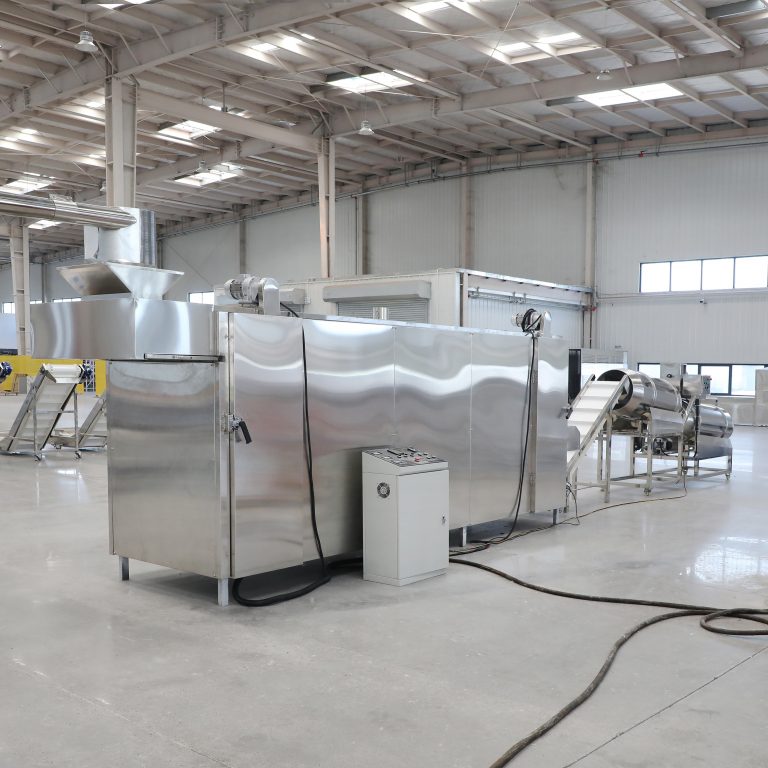
- Drying: can the oven remove the required water in the available residence time?
- Seasoning and cooling: can product remain free-flowing before packaging?
- Packaging: can the required retail bag count per minute be achieved?
Capacity is a chain. A line is not truly 300 kg/h if the dryer passes 300 kg/h of wet product but the packaging section can only handle 220 kg/h of finished product in the required bags.
5. Use a bottleneck table during quotation review
| Section | Supplier claim to request | Buyer verification |
|---|---|---|
| Extruder | Wet output and conditions used | Formula, moisture, die and steady-run duration |
| Dryer | Water removal, belt loading and residence time | Inlet/final moisture and product geometry |
| Seasoning/cooling | Finished product flow rate | Oil or powder loading and product temperature |
| Packaging | Bag/minute and net kg/h | Actual bag size, bulk density and checkweighing scope |
Use the lowest verified finished-product capacity as the provisional line capacity. Do not average several unrelated nameplate figures.
6. Factory acceptance should prove the linked system
A useful factory acceptance test is a stable production run, not a short demonstration of the extruder alone. Agree in advance on the formula, product size, test duration, output calculation, moisture method and quality checks.
- Run the complete line with the agreed product and formula.
- Record dry-feed rate, wet discharge rate and accepted finished output.
- Measure inlet and outlet moisture on the agreed basis.
- Record dryer zones, belt speed, airflow conditions and residence time.
- Inspect expansion, colour, texture, breakage and fines.
- Check seasoning, cooling and packaging at the same operating rate.
- Record stoppages, startup scrap and any material accumulation.
Published extrusion studies commonly collect samples after steady operation and record process variables such as feed moisture, temperature, screw speed and mechanical energy. Commercial FAT should follow the same principle: prove the process under stable, documented conditions.
7. Do not solve a dryer bottleneck by only increasing extruder speed
If the oven is limiting output, increasing extruder speed can create a larger wet-product queue, more damage during conveying, uneven drying and unstable packing. The solution may instead be a longer dryer, more zones, different belt loading, adjusted moisture, different product geometry, changed operating schedule or a revised capacity target.
Likewise, a dryer with spare thermal capacity may still be limited by loading, airflow distribution or the need to protect a delicate expanded product. Capacity planning should therefore include trial data and an operating margin, especially for multiple shapes or formulas.
8. What to send before requesting a line proposal
- Finished product photo, sample or clear product description
- Formula direction and target product range
- Dry-feed rate and required saleable output
- Inlet and final moisture targets with test method
- Piece dimensions, density and acceptable breakage
- Available heat source and factory utilities
- Seasoning, cooling and packaging requirements
- Expected operating hours, shifts and expansion plan
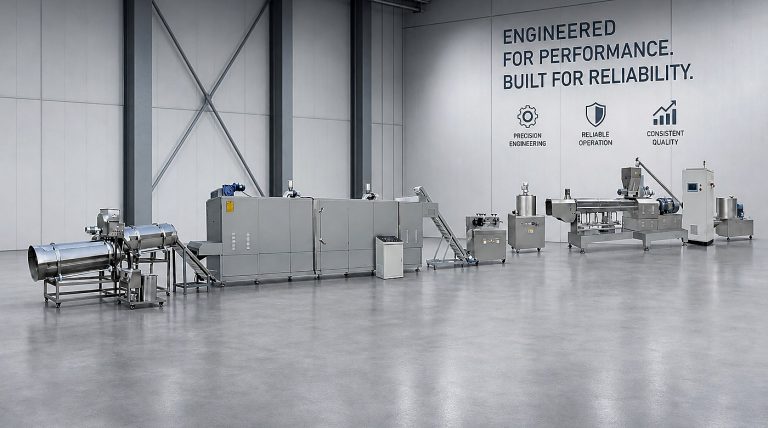
ZEKO can then size the twin-screw extruder, industrial dryer and downstream system as one route. For broader plant planning, see the factory requirements guide.
Conclusion
Match the extruder and oven by water removal, product behaviour and accepted finished output. A coherent line has no hidden wet-product queue, no unproven dryer duty and no packaging bottleneck that destroys the promised capacity. The right number is the stable packed kilograms per hour the factory can repeat.
Technical references
Continue Reading